Service · Chippewa Valley
Attic Spray Foam Insulation for Eau Claire Homes
Attic spray foam insulation in Eau Claire: roof deck or attic floor, R-49 to R-60 targets, ice dam prevention, free written estimates from licensed Wisconsin crews.
Serving Eau Claire, Chippewa Falls, Altoona, Menomonie, Lake Hallie and the surrounding Chippewa Valley
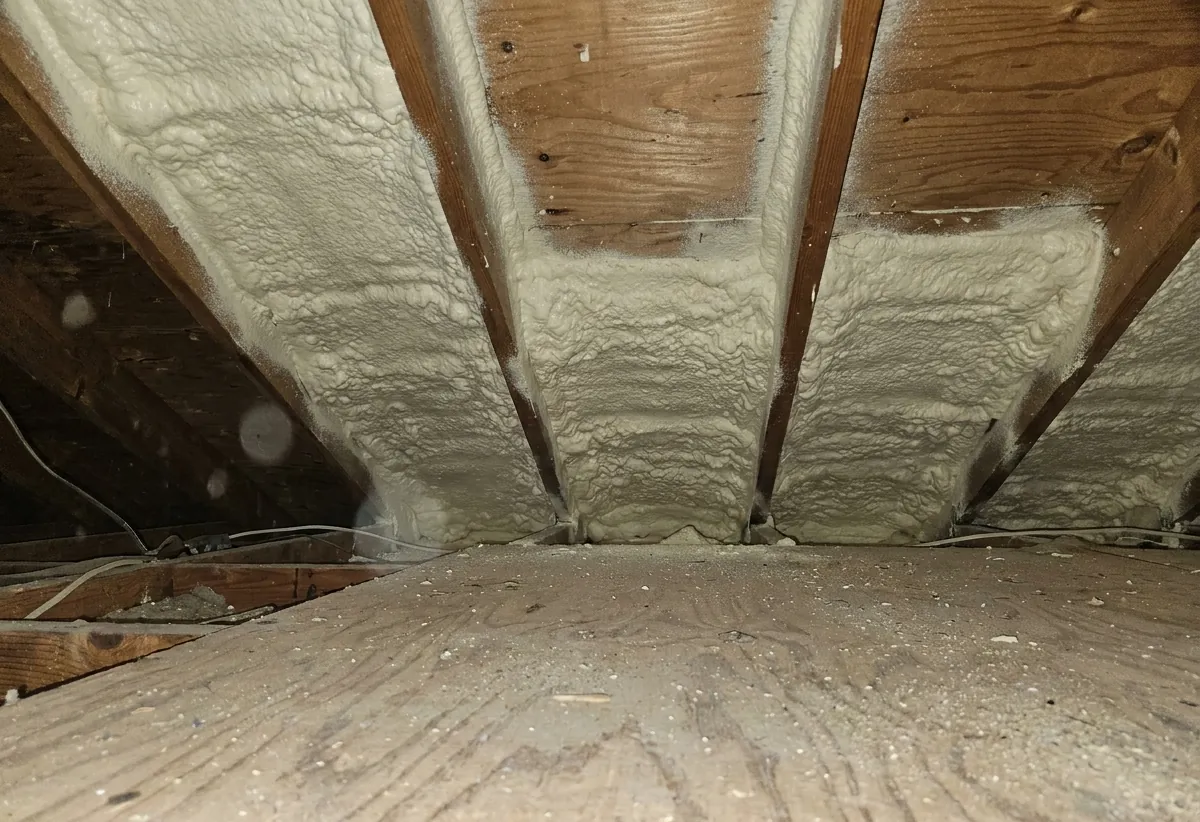
01 the ceiling plane
Every heated house pushes its warmest air at the ceiling, and in most of Eau Claire's housing stock the ceiling loses. Warm air finds the top-plate gaps, the wiring penetrations, and the chases, and carries paid-for heat into the attic all winter. Attic spray foam insulation closes that fight in one applied layer, sealing and insulating either the attic floor or the roof deck itself, installed to IRC foam plastic rules and aimed at the R-49 to R-60 range ENERGY STAR recommends for cold-climate attics.
The scale of the problem is documented. NAIMA, the insulation manufacturers association, estimates roughly 90 percent of existing US homes are under-insulated, a figure built on Residential Energy Consumption Survey data by Boston University and Lawrence Berkeley National Laboratory researchers, and EPA credits air sealing plus attic and crawl insulation with an average 15 percent saving on heating and cooling. The balloon-framed houses around the Third Ward and Randall Park sharpen the local version: their open wall chases run straight into the attic and work like chimneys for escaping heat.
Sometimes the honest answer is something less expensive than foam, and the recommendation here says so before anyone prices a job. When foam is the right call, Eau Claire Spray Foam Pro treats the attic as the highest-payback surface in the house: licensed and insured Wisconsin insulation contractors handle the work, and the estimate prices every board foot, deck or floor.
02 deck or floor
Roof Deck or Attic Floor: Two Ways to Foam an Attic
An attic floor application keeps the attic cold and vented the way the house was designed: the crew air-seals the top plates, wiring penetrations, and chases, then insulates directly above the ceiling. A roof deck application creates an unvented, conditioned attic instead, which the IRC permits when air-impermeable insulation is applied directly to the deck. The deck approach wins when the attic holds ductwork or mechanicals, because it pulls that equipment inside the thermal envelope. The floor approach usually wins on cost in a simple, empty attic. The assessment measures both paths, from hatch access to duct layout, and prices what fits the structure.
03 ice dams
Ice Dams End at the Ceiling Plane
An ice dam is not a gutter problem; it is an attic heat problem wearing a gutter disguise. Heat leaking through the ceiling warms the roof deck, the snowpack melts from the bottom, and the water refreezes over the cold eaves, backing up under the shingles. Heat cables and roof rakes treat the symptom every winter. Air-sealing the ceiling plane with foam removes the melt cycle at its source, the same envelope logic that applies down at the rim joist, where escaping basement heat starts the whole stack effect. One assessment can scope both ends. Call (715) 716-7940 to schedule it.
04 the numbers
Attic Spray Foam Cost in Eau Claire
National aggregator data for 2026 puts a 2,000 square foot attic done in closed cell between $2,500 and $4,000; the board-foot rates behind that figure live on the homepage rate table. Old insulation removal, tight hatch access, and deck-versus-floor scope move an Eau Claire quote inside or past that range, which is why the estimate here starts with an on-site measurement instead of a phone guess. The written quote states the target R-value per assembly and prices open and closed cell side by side wherever the attic allows a choice.
05 job day
How an Attic Foam Job Runs
The assessment takes about an hour and maps air leaks, existing insulation depth, and ventilation, and a written estimate follows inside two days. Install day covers most attics start to finish: masking, staged ventilation, foam applied in thin passes so each cures fully, and a depth check against the written spec before the crew leaves. Homes with attic-adjacent bedrooms get the cure window scheduled in advance, and attic work pairs naturally with crawl space insulation, sealing the envelope at both ends on one trip.
06 faq
Attic Spray Foam FAQ
How much foam does an attic need to reach R-49?
Reaching R-49 takes about 7 inches of closed cell spray foam or about 13 inches of open cell, based on aged R-values of roughly R-7 and R-3.7 per inch. The right number for your attic depends on framing depth, existing insulation, and whether the application lands on the deck or the floor. The estimate states the inch count and the R target for each assembly, so the number on paper is the number the crew sprays to.
Should the foam go on the roof deck or the attic floor?
The deck-or-floor call follows the mechanicals. If the attic holds ductwork, an air handler, or living-space kneewalls, foaming the deck brings that equipment inside the envelope and stops duct losses cold. If the attic is empty and vented, foaming the floor delivers the R-value at a lower installed cost. Both paths get priced in the written estimate whenever the structure genuinely supports either one.
Does attic spray foam stop ice dams?
Attic spray foam stops ice dams by removing the heat leak that creates them. With 55.4 inches of average annual snowfall in Eau Claire, any warm air escaping through the ceiling melts the snowpack from below and feeds refreezing at the eaves. Sealing the ceiling plane keeps the roof deck cold, so the snow stays frozen and drains as meltwater in spring instead of backing up under shingles in January.
Book the Attic Assessment
Start with the free assessment: an hour in the attic, straight answers, and a written number. Call or text (715) 716-7940, send the estimate form, or review the full service lineup on the Eau Claire Spray Foam Pro homepage. Whether the job is a bungalow attic in Randall Park or a farmhouse outside town, the estimate is free and the R target goes in writing.
Rather talk it through?
(715) 716-7940call or text, photos welcome
Request your free estimate
Tell us about the space and we’ll get back to you with a time for the free walkthrough.