Service · Chippewa Valley
Garage and Shop Spray Foam Insulation
Spray foam insulation for attached garages, detached shops, and rooms over the garage in Eau Claire. Open or closed cell, free written estimates.
Serving Eau Claire, Chippewa Falls, Altoona, Menomonie, Lake Hallie and the surrounding Chippewa Valley
01 the cold room
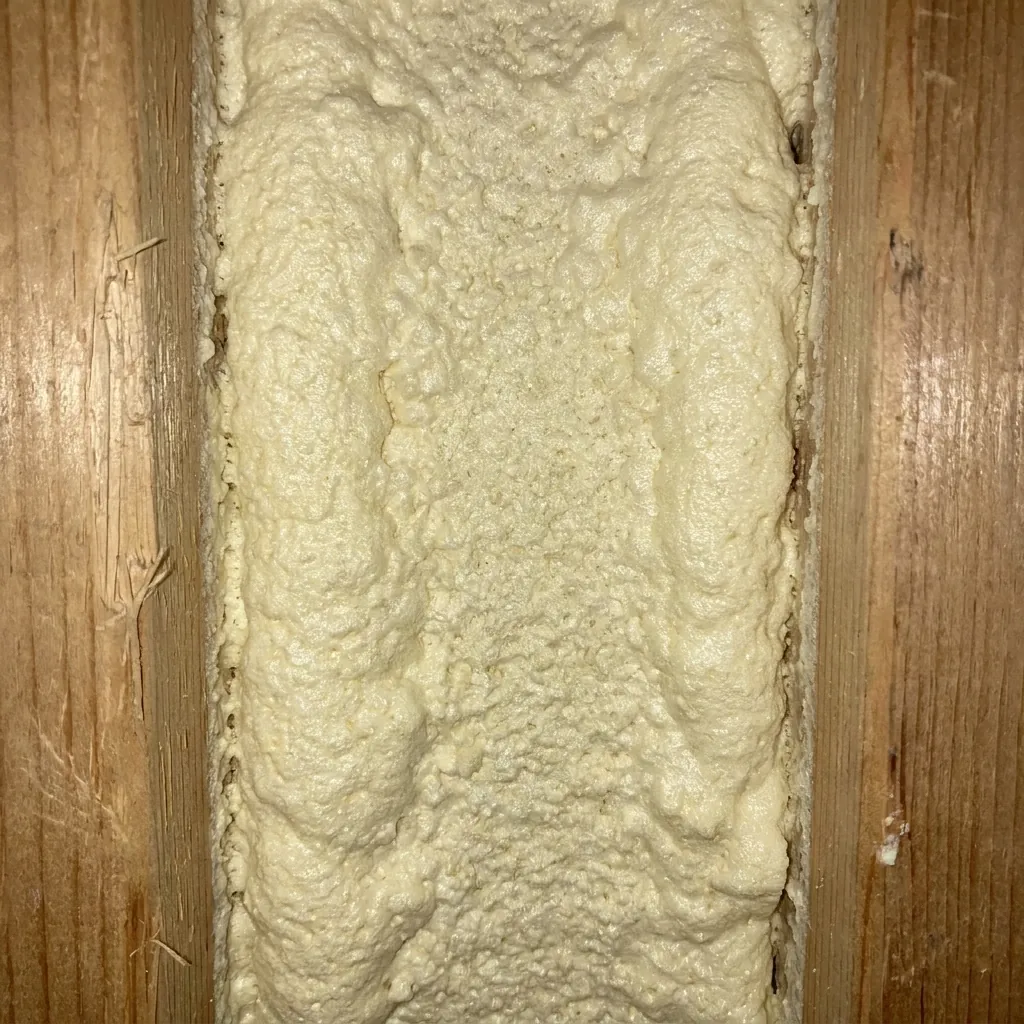
The coldest room in an Eau Claire house is usually not in the house. It is the garage bolted to its side, and the bedroom or bonus room riding above it inherits the chill through the floor. Garage spray foam insulation closes that gap in the envelope: foam in the walls, the band framing, and the ceiling turns a space the furnace was never meant to fight into one it can ignore, and turns a detached garage from three-season storage into a building with a thermostat of its own.
Most garages here were built as parking, then asked to be more. The framing tells the story: open stud bays or bare-minimum drywall over empty cavities, a band joist facing the driveway with nothing in it, and an overhead door that outnumbers every window in the house for area. In January the workbench is unusable and the car wears its ice all day; in April, humid air rolls in and sweats on every cold tool in the room. None of that is a heating problem. It is an envelope problem, and it is fixable in a day.
Not every garage earns the full package. Some need walls and ceiling both; plenty only need the shared wall and the band done right, and the advice here tells you which is which before money moves. The spraying itself is handled by licensed and insured Wisconsin crews from Eau Claire Spray Foam Pro, anywhere in the Chippewa Valley, with the estimate written after an on-site look.
02 attached or detached
Attached Garages and Detached Shops Are Different Jobs
An attached garage is really a house project. The wall it shares with the kitchen or living room, and the band framing that runs over the foundation, leak conditioned air out and pull garage air in, which is why code has long required a gypsum separation between garage and living space. That drywall is a fire detail, not an air seal; foam in the shared-wall bays and the band is what actually stops the exchange, and it makes the garage itself hold heat as a bonus. A detached garage or slab shop is the opposite: a small building job, priced as a wall-and-ceiling package like a compact version of the work on the pole barn and metal building page, which is also where true post-frame and steel structures belong.
03 over the garage
The Room Over the Garage Runs Cold
Ask anyone with a bonus room: the thermostat says 70 and the floor says otherwise. That room asks its floor to do a wall's job, holding the line against a freezing garage below, and builder-grade batts in the floor cavities sag away from the subfloor and quit at the edges. Foam solves it from the garage side: a lift across the garage ceiling, sealed band and cantilever framing at the edges, and attention to the kneewalls where the room narrows. The framing around that floor is close kin to the perimeter band detailed on the rim joist page, and it fails for the same reasons. Sealed and insulated, the floor drops out of the comfort argument and the room joins the rest of the house.
04 the price of warm
Pricing a Garage You Can Heat
National 2026 rates put garage and shop packages at $1.50 to $4.00 per square foot of treated wall and ceiling area: open cell runs $1.50 to $2.80 where the framing stays dry and the goal is warmth on a budget, and closed cell runs $2.00 to $4.00 where walls meet slab, behind steel liner panels, and on ceilings under living space. Small scopes carry a working floor around $700, because a shared-wall job mobilizes the same rig as a full shop. The spray foam cost calculator has a garage and shop setting that turns your square footage into a planning band, and the written estimate replaces the band with a measured number after a walkthrough, free.
05 spray to workshop
From Parked Cars to Working Space
The visit starts with what the garage is for: parking that should stop icing, a shop that needs steady heat, a gym that needs to stop smelling like winter. The crew checks framing depth, the door and its tracks, and what is stored against the walls, and the written number follows within a couple of days. On spray day the contents move to the center or out to the driveway, tracks, openers, and springs get masked, bays get sprayed to the specified depth, and the cure window closes out the afternoon. Most garages give up exactly one day of parking, and the first cold morning afterward makes the argument better than any brochure.
06 faq
Garage Insulation FAQ
Does spray foam in a garage need to be covered?
Usually, yes. Building codes want foam plastics behind a thermal or ignition barrier, and in a garage that is rarely a burden: the shared wall with the house already carries code-required drywall, ceilings under living space get drywalled in any finishing plan, and detached shop walls can take an ignition barrier coating or paneling if you want the studs left open for shelving. The written estimate states what each surface needs so there are no surprises at inspection time.
Open cell or closed cell for a garage?
Both have a lane. Open cell is the value play for framed walls in a dry, roofed garage: more thickness per dollar and a quieter room. Closed cell earns its premium where concrete, steel, or moisture is involved: the first courses above the slab, liner-panel walls, and the ceiling under a bonus room where vapor control protects the floor system. Where the framing genuinely allows either, the estimate prices both and says which one the building argues for.
Will insulation alone make the garage warm?
Insulation holds heat; it does not make it. What changes is the size of the heater the space needs and how long the warmth lasts. An uninsulated two-car garage loses a heater's output about as fast as it arrives, which is why the propane torpedo has to roar all Saturday. Foamed, the same garage holds working temperature off a modest unit heater, and a shop session no longer starts with an hour of warming up the walls.
Is the overhead door worth insulating too?
The door is the biggest hole in the wall, and it has a say in how warm the room ever gets. Foamed walls behind a bare steel door still make a cold garage, so the honest sequence is walls, band, and ceiling first, then an insulated door or an insert kit from a door supplier rather than foam sprayed on the panels, which adds weight and stiffness the door hardware was never sized for. The walkthrough prices what actually moves the temperature and says when the door, not the framing, is the next dollar's best home.
Make the Garage Part of the House
Whether it is a shared wall that leaks, a bonus room that never warms up, or a shop waiting for its first heated winter, the walkthrough is free and fits inside an hour. Call or text (715) 716-7940, send the form, or browse the rest of the lineup from the Eau Claire Spray Foam Pro homepage. One spray day, and the coldest room on the property changes sides.
Rather talk it through?
(715) 716-7940call or text, photos welcome
Request your free estimate
Tell us about the space and we’ll get back to you with a time for the free walkthrough.