Service · Chippewa Valley
Pole Barn and Metal Building Spray Foam Insulation
Closed cell spray foam for pole barns, shops, and steel buildings across the Chippewa Valley. Condensation control, real R targets, free written estimates.
Serving Eau Claire, Chippewa Falls, Altoona, Menomonie, Lake Hallie and the surrounding Chippewa Valley
01 the drip
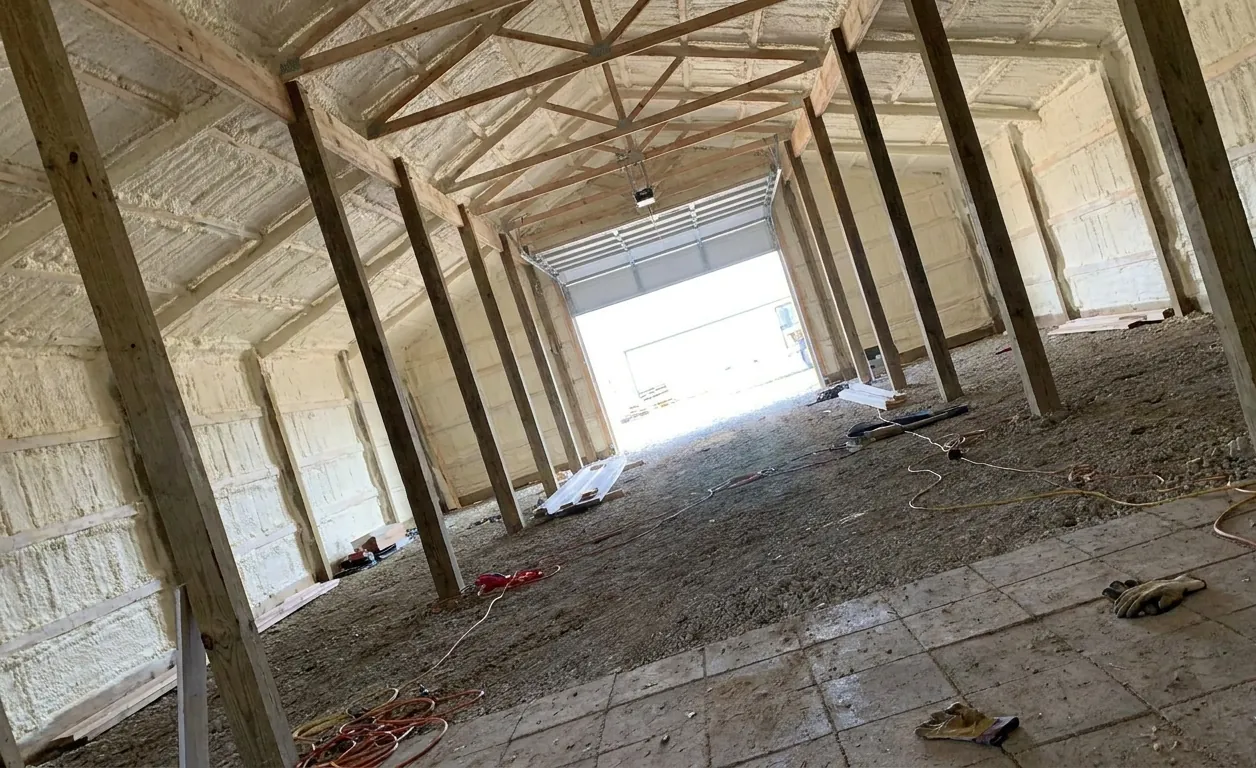
Bare steel drips. A post-frame building ordered the way most are, panels over framing with comfort deferred, has almost no insulating value in its skin: the metal conducts heat aggressively and sheds condensate the moment warm interior air touches a cold panel, which is why a shop you cannot heat is just expensive storage. Pole barn spray foam insulation is the step that finishes the building, two-component closed cell foam bonded directly to the panels, insulation and air barrier in one pass, and on steel that bond is the whole game.
A metal roof drips before a metal wall does, because night-sky cooling drops panel temperature below the dew point of the air trapped inside. Foam applied to the underside of the roof panels moves that condensing surface inside the insulation layer, where warm-side air never touches it. The metal trade's own guidance targets 30 to 50 percent indoor relative humidity to suppress visible condensation; foamed panels hold surface temperatures above the dew point even when a woodstove, livestock, or a parked snow-covered truck pushes humidity past that window.
The category is bigger than most people guess. The Metal Building Manufacturers Association reports that metal building systems account for nearly 30 percent of low-rise commercial construction in the United States, and the metal construction trade press documents what skipping insulation costs: corrosion, wetted stored equipment, rusted fasteners. The same buildings fill the rural parcels from Fall Creek to the town lines around Lake Hallie, machine sheds, hobby shops, horse barns, and small commercial bays, most of them waiting on someday.
Whatever the building holds, tools, livestock, or inventory, the paperwork works the same way: a quote by the square foot of treated surface and a plain answer on which walls, ceilings, and doors are worth foaming and which are not. Eau Claire Spray Foam Pro sprays post-frame and steel buildings across the Chippewa Valley with licensed and insured Wisconsin crews, and someday is a scheduling call away.
02 the spec sheet
Thickness Is a Written Spec, Not a Guess
Most pole barn walls perform well at 2 inches of closed cell, roughly R-14 plus an air seal that stops wind washing through panel laps and post connections. Roofs commonly spec between 2 and 3 inches, because the roof panel is where night-sky cooling pulls hardest. Buildings heated every day, spray booths, and living-quarters conversions justify more depth; cold storage justifies less. Whatever the number lands on, it goes on paper: the estimate states inches and R target per surface, so quotes get compared on the spec, not on an installer's mood.
03 holding heat
Heat You Can Actually Hold
An uninsulated 40 by 60 shop asks a furnace to reheat the entire volume every time the overhead door cycles. That 2 inch wall spec, air seal included, is what lets a single properly sized unit heater hold working temperature through an Eau Claire January instead of running flat-out to lose. Owners who store water systems or hydraulics get the same protection a house gets from rim joist sealing: the plumbing stops living on the weather side of the insulation.
04 spray day
How a Building Gets Sprayed
The walkthrough measures panel area, checks purlin and girt spacing, and flags wash lighting, ceiling fans, and anything that needs masking, and the written estimate follows in a day or two with thickness and R target stated per surface. Spray day runs one to two days for most buildings: surfaces masked, foam applied with substrate temperature checked so each lift cures at rated density, and a thickness verification before the trailer leaves. Buildings with slab moisture questions get the same evaluation logic used in crawl space insulation work: find the water path first, then insulate.
05 cost per surface
Pole Barn Insulation Cost per Square Foot
Current national aggregator ranges put pole barn and metal building spray foam at $1.00 to $4.50 per square foot of treated surface depending on foam type and thickness, with typical full-building projects landing between $3,500 and $16,500. Retrofit work on an occupied building prices above new-shell work because of prep and access. A written Eau Claire Spray Foam Pro estimate prices your actual panel area, in writing, free. Call (715) 716-7940 and put a number on the building instead of a guess.
06 faq
Pole Barn Insulation FAQ
Should the foam go on the roof panels or on a ceiling?
Foaming the roof deck conditions the building to the ridge and kills the drip at its source, which suits shops that use their height for lifts, racking, or a mezzanine. Hanging a steel liner ceiling and insulating above it shrinks the volume you pay to heat, but it leaves the panels above cold and condensation-prone unless that dead attic space is vented right. The walkthrough looks at how the building actually gets used and specs the version that fits.
Will foam stop the roof from dripping?
Foam stops the drip by keeping interior air away from cold steel. Condensation needs a surface below the dew point; once panels carry closed cell's aged R-value, the exposed surface stays near room temperature and the water vapor stays vapor. The relative humidity window the metal building trade recommends becomes easy to hold instead of impossible.
Can spray foam go into a pole barn in the middle of winter?
Yes, and plenty of it goes in exactly then, because winter is when an unheatable building hurts. The limit is panel temperature, not the calendar: foam cures at rated density when the substrate is warm enough, so cold-season jobs run with the building warmed ahead of the crew and the panel temperature checked before each lift. What winter mostly changes is scheduling, and the estimate says so up front.
Can foam go over the vinyl-faced insulation already in the walls?
Not through it, no. Foam needs bare, clean panel to bond as an air barrier, and a vinyl-faced blanket is a slip surface with moisture history trapped behind it. Sagging blanket comes down before anything gets sprayed, and that tear-out is part of why retrofit work prices above a bare new shell: the crew masks it, pulls it, and hauls it before the first lift goes on.
Does an existing pole barn cost more to foam than a new build?
An existing building typically prices 15 to 25 percent higher than a bare new shell, per national aggregator data, because contents get moved and masked, panels get cleaned, and access takes staging. The offset is that retrofit owners feel the payoff immediately: the building they could not keep warm last winter holds temperature the week after spray day.
Put a Number on the Building
The estimate is free, the measurement is exact, and the quote is built so you can phase walls, roof, and doors. Call or text (715) 716-7940 or start from the Eau Claire Spray Foam Pro homepage service overview. From machine sheds outside Fall Creek to commercial bays in town, steel buildings here earn their insulation.
Rather talk it through?
(715) 716-7940call or text, photos welcome
Request your free estimate
Tell us about the space and we’ll get back to you with a time for the free walkthrough.