Service · Chippewa Valley
New Construction Spray Foam Insulation
Spray foam for new construction walls in Eau Claire: open or closed cell between rough-in and drywall, R targets per assembly, free written estimates.
Serving Eau Claire, Chippewa Falls, Altoona, Menomonie, Lake Hallie and the surrounding Chippewa Valley
01 the open week
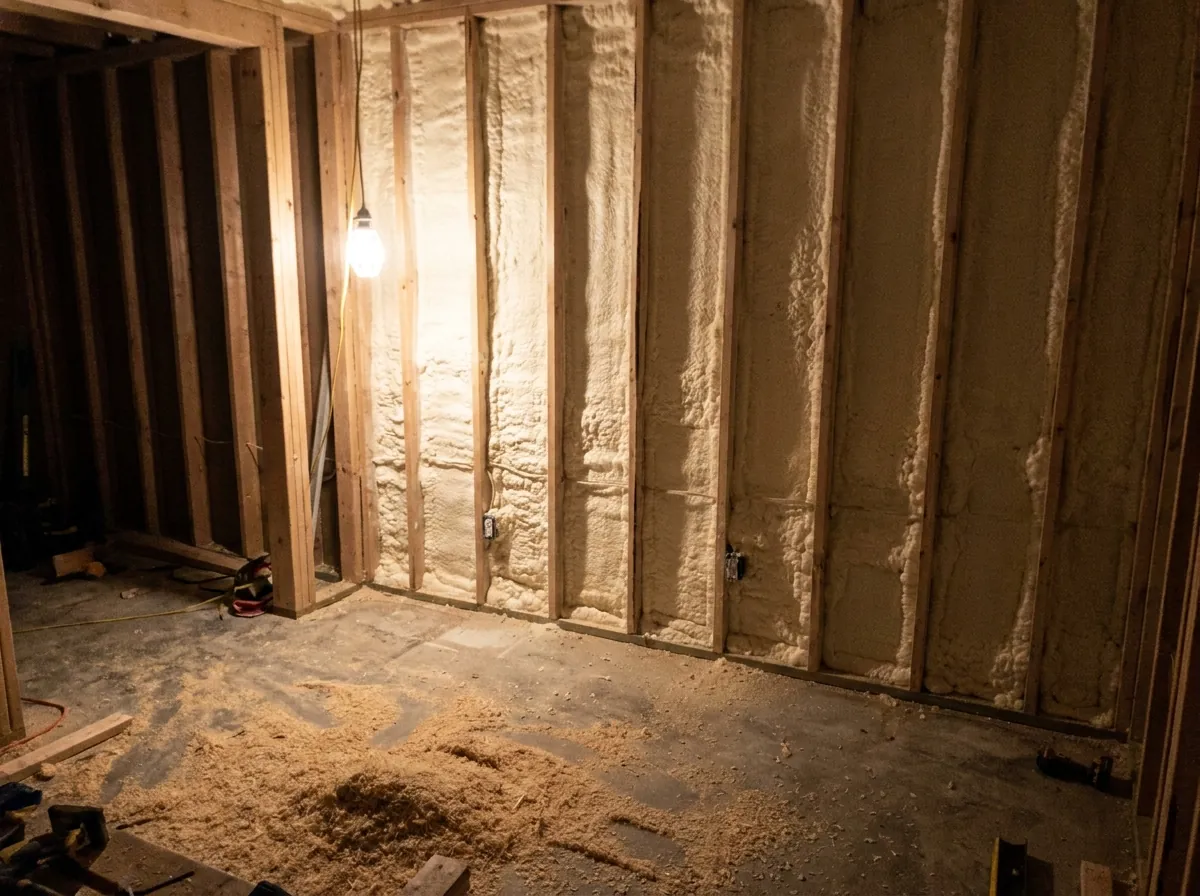
Every framed house offers its insulation contractor one clean shot: the stretch after rough-in passes inspection and before the drywall stacks arrive. New construction spray foam insulation uses that window to do what no retrofit can match, filling open stud bays with foam that insulates and air-seals in the same lift, every cavity visible, every penetration reachable, nothing to tear out first. Open framing is why sprayed walls price lower in a new build than the same walls ever will again.
The spec question is real, because foam changes what a wall assembly is. Sprayed against the sheathing, closed cell bonds framing and skin into a stiffer panel, adding racking strength in the same pass, while open cell at full depth turns a stud bay into a sound absorber between bedrooms and street. Either way the wall stops leaking air at the top plates, the outlet boxes, and the sill, which is where framed houses actually lose their heat.
Builders schedule this work by the subdivision; owners building once get the same crew and the same paperwork. Eau Claire Spray Foam Pro walks the framed shell with licensed and insured Wisconsin crews, prices open and closed cell against the same walls, and puts the R target for every assembly in a free written estimate.
02 open or closed
Open Cell or Closed Cell in a Framed Wall
The two foams split a wall decision by depth, budget, and what else the assembly has to do. Open cell at full stud depth is the volume play: about R-20 aged in a 2x6 bay at R-3.7 per inch, the quietest wall of the options, and the lowest cost per cavity. Closed cell runs R-7 aged per inch, so it wins wherever depth is scarce, 3 inches in a 2x4 bay reaches roughly R-21, and at 2 inches it doubles as a Class II vapor retarder against a Wisconsin winter's vapor drive. Some builders split the difference, a thin lift of closed cell against the sheathing with batts filling the rest of the bay, and the estimate can price that flash-and-batt hybrid alongside the full-foam options when a budget asks for it.
03 the code math
What Wisconsin's Dwelling Code Asks of a New Wall
Wisconsin writes its energy rules for new homes in SPS 322 of the Uniform Dwelling Code. On the prescriptive table, a wood-frame wall in an Eau Claire build needs R-20, or R-13 in the cavity plus R-5 of continuous sheathing, with ceilings at R-49; builders who would rather trade assemblies against each other can comply through the code's UA calculation instead, which accepts a REScheck report. Two provisions read like they were written with foam in mind. Box sills and joist spaces at outside walls can meet the wall R-value with air-impermeable insulation sealed on all sides, which describes closed cell in a rim bay almost word for word, and the code applies its vapor retarder rules to every insulated dwelling, where 2 inches of closed cell already rates as a Class II retarder on its own.
04 who decides what
Builder Decisions, Owner Decisions
The split of decisions is predictable. The builder owns sequence: foam goes in after rough-in inspections pass and before drywall, and the sprayer needs the shell weathertight first. The owner owns the comfort questions: which bedrooms deserve the sound package, whether the bonus room over the garage gets closed cell under its floor, how much of the budget goes to the walls versus the attic above them. Mechanical trades sit in the middle, since foam locks in whatever wiring and plumbing the bays hold on spray day. The walkthrough sorts all of it into a per-assembly plan, and the one rule that protects everybody is simple: changes cost little before the foam goes on and plenty after.
05 the package price
What New Construction Wall Foam Costs
For a 2x4 wall filled to full depth, 2026 national aggregator data runs $1.40 to $2.28 per square foot of wall in open cell and $3.50 to $5.25 in closed cell, and most whole-house packages land between those poles because the plan mixes foams by assembly. The site's cost calculator carries an open-framing wall band of $1.50 to $3.00 per square foot for exactly that reason. Depth, the open-versus-closed split, and how many assemblies join the package move the number more than raw square footage does, and a one-room scope still books the full rig, so small jobs bottom out around $900. The estimate replaces all of it with one written figure per assembly, measured on the actual framing, free.
06 faq
New Construction Insulation FAQ
Can the walls be foamed with wiring and plumbing already in the bays?
That is the normal condition, not a complication. Foam flows around boxes, wire runs, and supply lines, and sealing the spots where they punch through plates is half the point of the product. What matters is order: electrical and plumbing rough-ins pass inspection first, then foam, because moving a receptacle inside a sealed bay is the kind of change nobody prices kindly. Get the layout right, then make it permanent.
Does a foamed house still need house wrap?
Yes. Wrap and foam solve different problems: the wrap sheds bulk water outside the sheathing, the foam stops air and heat movement inside the cavity. Foam replaces the batt-and-poly conversation on the warm side of the wall, not the drainage plane on the cold side. The builder's exterior detail stays exactly as drawn.
How long after spraying can drywall go up?
Quickly. Manufacturer reoccupancy guidance commonly runs 24 hours, proud foam gets trimmed back flush before the crew leaves, and the bays meet the drywallers flat and dry. On most schedules foam costs the calendar a day, not a week, and it hands time back later because there is no batt-stapling pass to wait on.
Do the rim joist and garage get sprayed on the same visit?
Usually, and the estimate prices it that way. The rig that fills wall bays finishes the band joist in the same setup, and an attached garage's shared wall takes minutes while the hoses are hot. Whole-shell packages, walls, rim, and garage together, are where new-construction pricing earns its reputation.
Foam the Shell While It Is Open
A framed shell takes its foam faster, cheaper, and cleaner than the same house ever will again, and the window closes when the drywall stacks arrive. Call or text (715) 716-7940, send the form, or start from the Eau Claire Spray Foam Pro homepage service lineup. The walkthrough fits between inspections, and the estimate arrives written, R target stated per assembly.
Rather talk it through?
(715) 716-7940call or text, photos welcome
Request your free estimate
Tell us about the space and we’ll get back to you with a time for the free walkthrough.