Service · Chippewa Valley
Crawl Space Spray Foam Insulation and Encapsulation
Crawl space spray foam and encapsulation in Eau Claire: sealed liners, closed cell walls, flood-resistant material, free written estimates.
Serving Eau Claire, Chippewa Falls, Altoona, Menomonie, Lake Hallie and the surrounding Chippewa Valley
01 under the house
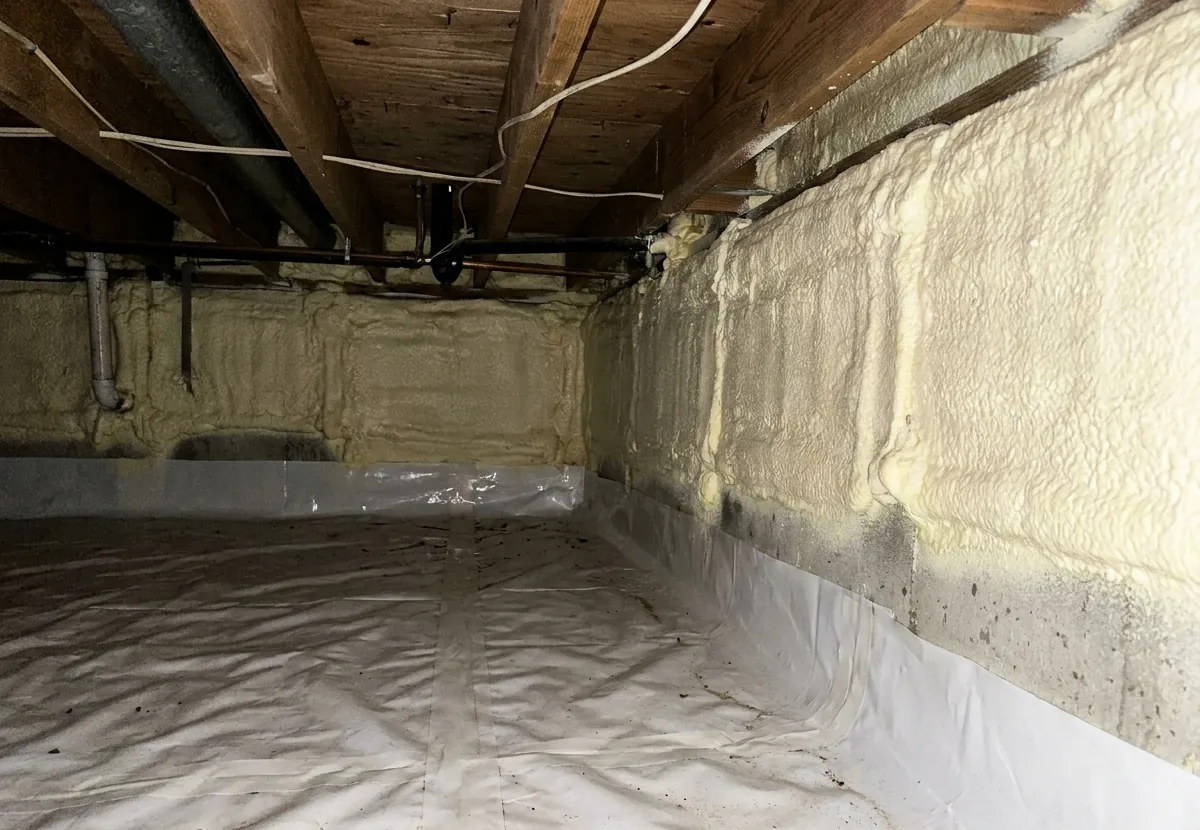
Cold floors and a musty smell upstairs are usually the house reporting on its crawl space. Crawl space spray foam insulation fixes the report at its source, sealing the foundation walls and framing so ground moisture, soil gases, and outdoor cold stop migrating into the floors above. In most homes it pairs with encapsulation, a sealed ground vapor barrier plus closed cell on the walls and rim, converting a vented dirt cave into a dry, conditioned buffer zone. The approach treats the crawl space as part of the house, because air-wise, it already is.
Eau Claire's geography makes the case sharper than most places. The city sits at the confluence of two rivers, absorbs 32.99 inches of precipitation in a normal year, and pushes frost deep enough that Wisconsin's Uniform Dwelling Code, SPS 321.16, sets minimum footing depth at 48 inches. Older homes near the river flats ride on damp block foundations, their vented crawl spaces pull humid summer air across cold surfaces, and the water condenses onto joists exactly where nobody looks. FEMA lists closed cell foam among flood-damage-resistant materials, one of the few insulation types that survives a wetting event intact.
Moisture first, insulation second: that is the order every crawl space job here runs in. Licensed and insured Wisconsin crews from Eau Claire Spray Foam Pro seal, foam, and condition the space, and the estimate says plainly whether yours needs the full encapsulation or just the walls and rim.
02 vented vs sealed
Why Vented Crawl Spaces Fail in Wisconsin
The vented crawl space was designed to dry itself with outdoor air, and in a humid Midwest summer it does the opposite: warm air enters, touches cool foundation surfaces, and drops its moisture as condensation. Winter reverses the damage, pouring freezing air under the floors and around plumbing. Sealing the vents, foaming the walls with closed cell at roughly 2 inches for a Class II vapor retarder, and grounding the floor with a sealed liner breaks both cycles at once. Floors warm up, musty smells fade, and the stack effect stops hauling crawl air up into the living space.
03 dew point
Moisture, Mold, and the Dew Point
Condensation in a crawl space follows one rule: any surface colder than the point where air saturates will collect water, and biology does the rest. Closed cell foam raises those surface temperatures above the threshold and refuses to absorb water itself. The same physics protects everything from duct runs to supply plumbing, and the rim joist above the foundation wall, the coldest framing in the house, gets sealed on the same visit.
04 the ranges
Crawl Space Encapsulation Cost in Eau Claire
Plan around the national 2026 ranges: $2 to $5 per square foot for spray foam under the house, $3 to $10 per square foot for full encapsulation, project totals commonly between $1,500 and $15,000 depending on size, access height, and standing moisture issues that need correcting first. Pre-existing mold or drainage repairs add real cost and get called out separately, never buried in the foam price. The written estimate covers liner, foam, and any prep, free, after an on-site look.
05 the sequence
Liner First, Foam Second
The assessment crawls the space with a moisture meter and a flashlight: liner condition, standing water history, vent count, rim condition, duct and plumbing runs. The scope arrives in writing a day or two later. Work runs one to two days for most homes, in order: ground liner sealed to the walls, vents closed for good, closed cell applied to walls and rim, and a final thickness and seal check. Homes losing heat at both ends pair the crawl with attic insulation, closing the envelope top and bottom in one project.
06 faq
Crawl Space Insulation FAQ
Should a Wisconsin crawl space be vented, sealed, or foamed?
Sealed wins in Wisconsin's climate. A vented crawl space imports humid air all summer and freezing air all winter, and building science moved decisively toward sealed, conditioned crawl spaces for exactly that reason. With 32.99 inches of annual precipitation feeding ground moisture around Eau Claire foundations, the sealed liner plus foamed walls approach keeps the space dry year-round instead of alternating between damp and frozen.
Is spray foam safe around the furnace and water heater in a crawl space?
Spray foam near mechanicals is handled by code, not guesswork. IRC foam plastic rules require an ignition barrier over foam in crawl spaces, and combustion appliances keep their required clearances and combustion air supply. The crew masks equipment during the spray, and the walkthrough verifies barriers and clearances before the job closes out. A cured, code-covered installation is inert plastic sitting on block, nothing more reactive than that.
How much does crawl space insulation cost for a typical older home?
Crawl space insulation and encapsulation for a typical older home lands inside the national $1,500 to $15,000 project range, with $5,500 the commonly cited average and $3 to $10 per square foot the working math. Eau Claire quotes move within that band on access height, liner area, rim length, and whether moisture repairs come first. The free on-site measurement replaces the range with one written number.
Does crawl space work stop for the winter?
No. The crew works under the house and out of the weather, and a sealed, conditioned crawl starts earning its keep in the coldest weeks instead of waiting for spring. The requirement that matters is the one spray foam always carries, surfaces warm enough for the foam to cure at rated density, and conditioning the space during the work covers it. Standing water still stops a job in any season; that gets corrected before anyone sprays.
Get the Crawl Space Looked At
A dry crawl space is the cheapest comfort upgrade most older Eau Claire homes can buy. Call or text (715) 716-7940 for the free assessment, or start at the Eau Claire Spray Foam Pro homepage for the full service picture. One visit, one written number, and the space under your floors stops being the dampest room in the house.
Rather talk it through?
(715) 716-7940call or text, photos welcome
Request your free estimate
Tell us about the space and we’ll get back to you with a time for the free walkthrough.