Service · Chippewa Valley
Basement Wall Spray Foam Insulation
Basement wall spray foam insulation in Eau Claire: closed cell on block and poured walls, finish-ready assemblies, free written estimates.
Serving Eau Claire, Chippewa Falls, Altoona, Menomonie, Lake Hallie and the surrounding Chippewa Valley
01 half the house
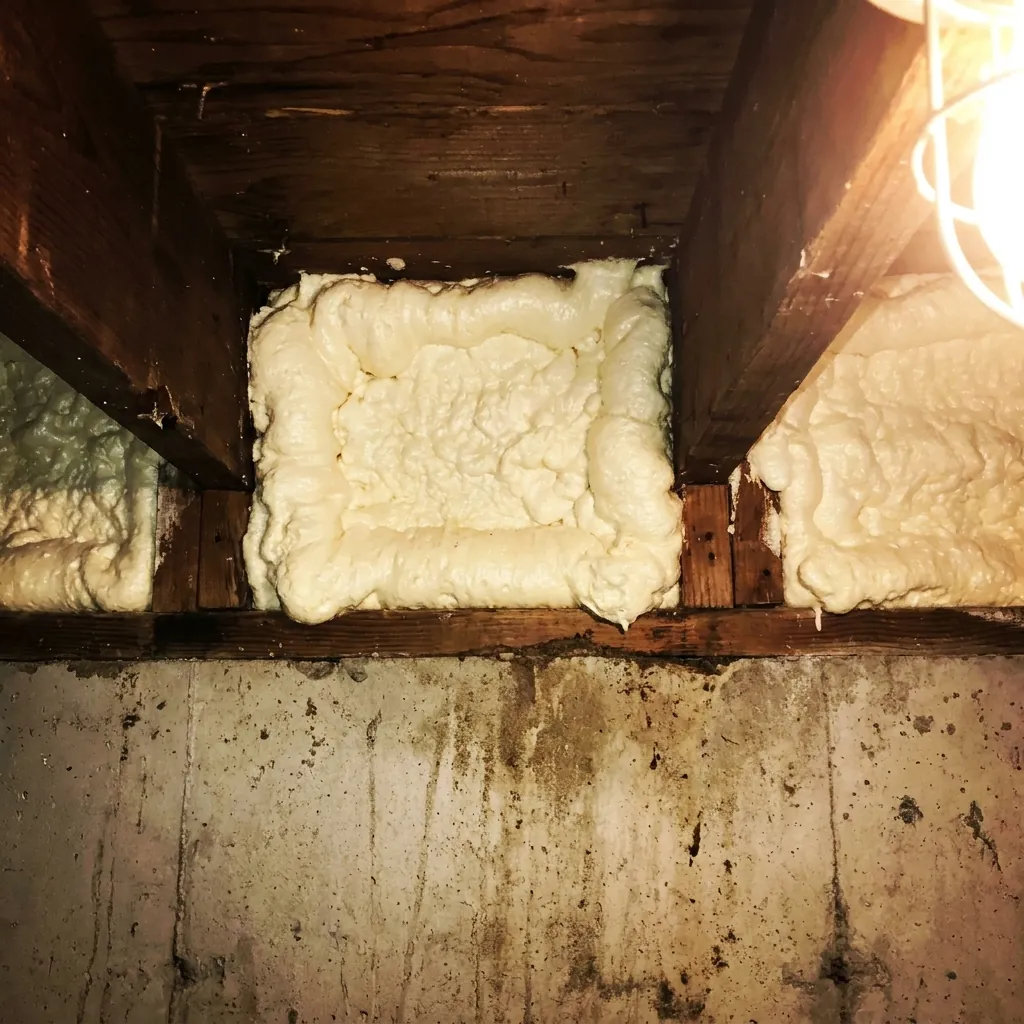
An unfinished basement is the cheapest square footage a homeowner already owns, and the walls are the reason it still feels like a cellar. Concrete does not read cold on the thermostat; it reads cold on your ankles, on the laundry chore that gets rushed, on the treadmill nobody visits after Thanksgiving. Basement wall spray foam insulation changes what the room is: closed cell bonded straight to block or poured concrete delivers insulation, air sealing, and vapor control in a single application, and leaves a wall that is ready to frame and finish whenever the budget says go.
The physics work against a bare wall from both directions. Above grade and through the shallow frost band, winter pulls heat out through the concrete; below that, the ground holds the wall at cellar temperature year round while damp soil pushes moisture vapor inward through material that was never meant to stop it. The furnace and water heater usually live down there, working in the coldest room they serve, and every degree they lose to the walls gets bought again upstairs.
On concrete, the recommendation is closed cell, and it does not hedge. Eau Claire Spray Foam Pro insulates basement walls as their own project or as the anchor of a full basement finish, with licensed and insured Wisconsin crews and an estimate that is written only after a walkthrough has looked at the water story, never before.
02 concrete and batts
What Concrete Does to Fiberglass
The classic Wisconsin basement finish starts backwards: build a stud wall, stuff it with batts, sheet it in poly and drywall. The assembly looks right and behaves wrong. Room air slips behind the framing, touches concrete that spends most of the year well below room temperature, and drops its moisture there, so the cavity grows damp batts, rusted screws, and that basement smell no candle fixes. Closed cell foam removes the meeting point entirely: bonded to the masonry with no gap behind it, it keeps interior air off the cold face, adds real R-value, and acts as its own vapor retarder. The framing then stands inside the insulated line, dry, and the bays stay empty for wiring instead of holding wet fiberglass.
03 foam before framing
Insulate Before the Studs Go Up
Sequence decides how well a finished basement ages: foam first, frame second, drywall third. The foam goes on while the walls are open and reachable, the stud wall floats just inside it, and the drywall most finishing plans already include doubles as the thermal barrier building codes ask for over foam plastics. Energy code tables for a climate like this put continuous basement wall insulation in the neighborhood of R-15, which closed cell reaches in a bit over two inches, and the written estimate states the inches and the R target for the wall before any spraying starts. Walkout walls and egress framing get treated as the house walls they are, and the band joist ringing the top of the foundation is its own high-leverage job, priced by the linear foot on the rim joist page.
04 wall math
What Basement Walls Cost to Foam
National 2026 rates for closed cell on basement walls run $2.00 to $6.00 per square foot of wall area, with small scopes carrying a working floor around $900 because a half-wall job mobilizes the same equipment as a whole perimeter. Wall height, obstructions along the perimeter, and any moisture prep move a project inside that spread. The spray foam cost calculator has a basement walls setting that turns your wall footage into a planning band, and pairing the walls with a rim seal or attic work puts the rig's whole visit to use. The written estimate that follows the free walkthrough replaces every range on this page with one measured figure.
05 water first
Wet Basements Get Fixed Before They Get Foamed
Foam is insulation, not waterproofing, and pretending otherwise buries a problem behind a finished wall. A basement that takes on water at the cove, shows efflorescence blooming through the block, or runs a sump like a spring creek needs its drainage story solved first: grading, gutters, and where it comes to it, drain tile. The walkthrough reads those signs honestly, and if the answer is fix the water first, that is the answer that gets said. Closed cell shrugs off damp air and incidental contact once the bulk water is handled, which is exactly why it is the right material down here and why order matters. Houses where part of the footprint sits over a dirt-floor space are a different scope altogether: that is crawl space encapsulation, with its own page and its own sequence.
06 faq
Basement Insulation FAQ
Why closed cell and not batts or foam board on basement walls?
Concrete demands a material that can touch it without consequences. Batts absorb moisture and feed mold in below-grade cavities. Rigid foam board can work, but it depends on flawless glue-and-tape detailing to stop air from circling behind the panels, and every seam is a future gap. Spray-applied closed cell bonds continuously to block and poured walls alike, follows every irregularity, and needs no seams, tape, or luck. On this one surface the recommendation does not hedge.
Can drywall go straight over the foam?
The foam needs a code thermal barrier between it and the living space, and half-inch drywall is the standard answer, so a normal basement finish satisfies the requirement without any extra step. The stud wall simply frames up inside the foamed perimeter and takes drywall as planned. In basements staying unfinished as storage or mechanical space, an ignition barrier coating over the foam handles it instead, and the written estimate says which treatment the space calls for.
Is it worth foaming the walls if we are not finishing the basement?
Sometimes the honest answer is not yet. If the goal is warmer floors upstairs and lower bills, the rim seal usually comes first and the attic competes for the same dollars. Foamed walls earn their keep when the basement itself gets used: a laundry that is not punishment, a workshop, a rec room on the five-year plan, or a mechanical room that stops bleeding heat into concrete. The assessment weighs those uses with you before anything gets sprayed.
Turn the Basement Into Finished Space
Whether the plan is a full basement finish next year or just walls that stop acting like a cellar, the walkthrough costs nothing and the number arrives written. Call or text (715) 716-7940, send the form, or size up the rest of the house from the Eau Claire Spray Foam Pro homepage. The cheapest square footage you will ever add is the square footage already under the house.
Rather talk it through?
(715) 716-7940call or text, photos welcome
Request your free estimate
Tell us about the space and we’ll get back to you with a time for the free walkthrough.