Service · Chippewa Valley
Rim and Band Joist Spray Foam Insulation
Rim and band joist spray foam sealing in Eau Claire: two inches of closed cell stops drafts and frozen pipes. Free written estimates.
Serving Eau Claire, Chippewa Falls, Altoona, Menomonie, Lake Hallie and the surrounding Chippewa Valley
01 150 linear feet
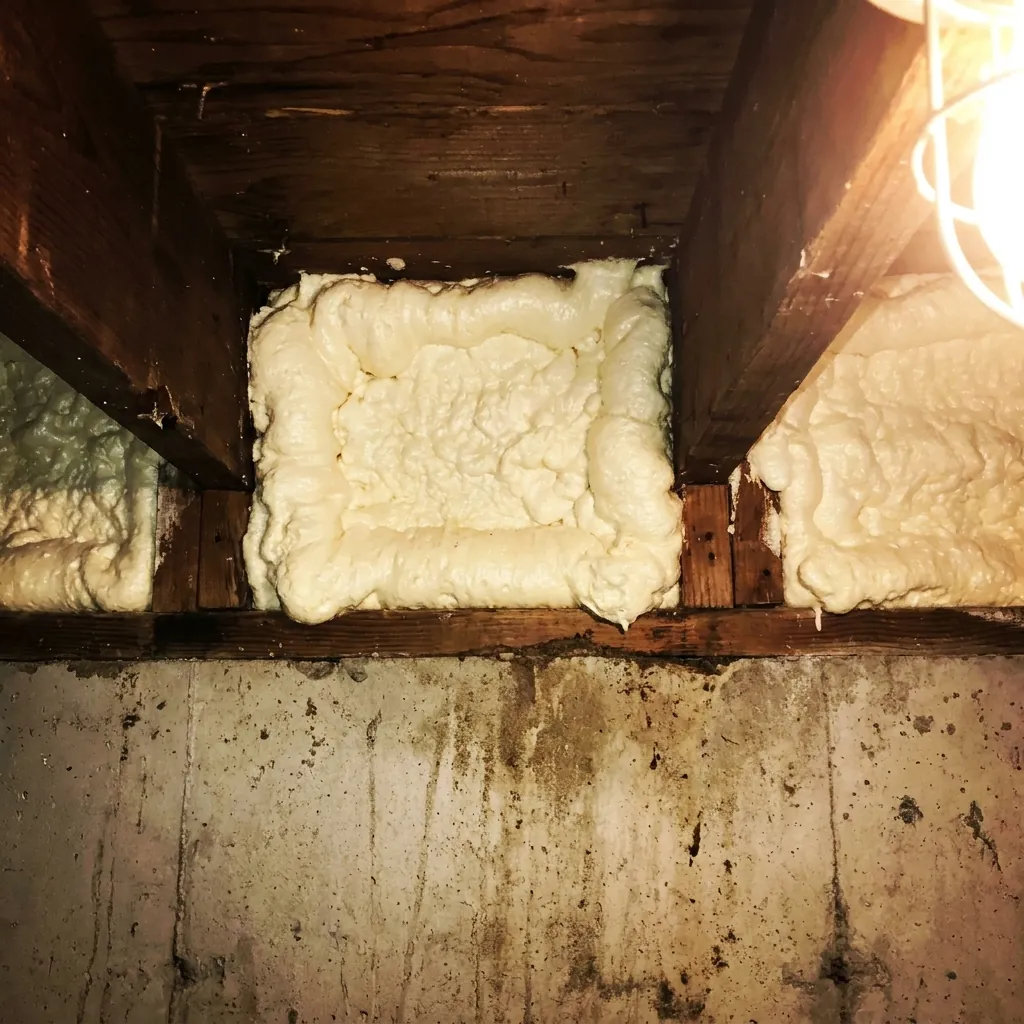
There is a strip of framing in every basement, about 150 linear feet of it in a typical home, that nobody ever looks at and everybody pays for. Rim joist spray foam insulation seals that perimeter band where the floor system meets the foundation, the coldest and leakiest wood in the house, and replaces the stuffed fiberglass batts that generations of Wisconsin homeowners wedged into those cavities. Two inches of closed cell bonds to the rim, delivers roughly R-14, and closes the gap between sill plate and subfloor as one continuous air barrier.
The number comes first here: a written per-linear-foot price, measured in your basement by licensed and insured Wisconsin crews. Eau Claire Spray Foam Pro seals rims as a standalone job or as phase one of a larger envelope project, and nobody will pressure you into buying more building than the fix requires.
02 by the foot
Rim Joist Sealing Cost by the Linear Foot
Rim work prices by the linear foot of band joist and the depth sprayed. At national 2026 closed cell rates of $1.00 to $1.50 per board foot, a typical home's rim at 2 inches lands in the hundreds for most homes, and it adds little when bundled with crawl space insulation or attic work, since the rig is already on site. The written estimate states linear footage, depth, and R target: the smallest, highest-leverage job in home insulation, priced for your basement.
03 batts vs foam
Why Fiberglass Fails Where Foam Succeeds
A fiberglass batt in a rim bay is a filter, not a seal: air moves straight through it, cools, and condenses moisture into the batt against the cold wood. That is why pulled batts so often come out damp or mouse-tunneled. Closed cell foam does the opposite, bonding to wood and concrete, sealing the sill plate seam, and putting the condensing surface inside the foam where household air cannot reach it. The batt made the rim look insulated; the foam makes it stop leaking.
04 frozen pipes
Frozen Pipes and the 45 Below Problem
The building science on this strip is unambiguous. ENERGY STAR's basement air-sealing guidance singles out the rim joist cavities and the penetrations that cluster there, water supply lines, drain pipes, the vent stack, the furnace flue, wiring, and notes that the leakage cracks are usually invisible from inside. Cold floors over the basement, pipes that need babysitting through a January cold snap, and that draft across the family room all trace back to the same framing.
Pipes freeze where plumbing meets outside air, and the rim is where both crowd together: supply lines hug the perimeter, and the leaks cluster at the same penetrations ENERGY STAR flags. Sealing the rim moves the freeze line outside the envelope, which is why rim work is the cheapest insurance an Eau Claire basement can carry into a cold snap. The same logic scaled up is what pole barn insulation does for a whole steel building: put the air seal between the weather and the water.
05 faq
Rim Joist Insulation FAQ
How thick should closed cell foam be on a rim joist?
Two inches is the working spec for a Wisconsin rim: roughly R-14 of aged R-value plus a Class II vapor retarder, enough to seal air and control condensation without overfilling bays that plumbing and wiring still need to pass through. Deeper pours are available where a homeowner wants more R, but 2 inches is where the performance-per-dollar curve peaks.
Can the old fiberglass insulation stay in the rim bays?
The old fiberglass comes out before foam goes in. Batts hold dust, moisture history, and often rodent traffic, and foam needs clean wood to bond as an air seal. Pulling them is fast, they compress into a few contractor bags, and what the crew finds behind them, staining, gaps at the sill, daylight at penetrations, usually explains exactly where the winter drafts were coming from.
Does rim joist foam really help with frozen pipes?
Rim foam is the single most direct frozen-pipe prevention a basement can get. Pipes freeze where leaking outside air washes over them, and the rim is the loudest leak in the house on the coldest night of the year. Sealing it puts still, basement-temperature air around the plumbing instead of a moving wind chill. Paired with normal cold-snap practice, it takes the perimeter supply lines off the worry list.
Seal the Coldest Framing First
If a house gets one envelope fix before winter, the rim is the highest-leverage candidate. The assessment costs nothing and takes about an hour, a walk of the basement perimeter that counts penetrations and checks the sill for moisture history, with the rest of the house looked at in the same visit if you want it, and the number follows in writing a couple of days later. Call or text (715) 716-7940 to put it on the calendar, or see how rim sealing fits the whole-house picture on the Eau Claire Spray Foam Pro homepage.
Rather talk it through?
(715) 716-7940call or text, photos welcome
Request your free estimate
Tell us about the space and we’ll get back to you with a time for the free walkthrough.