01 the numbers first
Closed Cell Spray Foam vs Open Cell, Property by Property
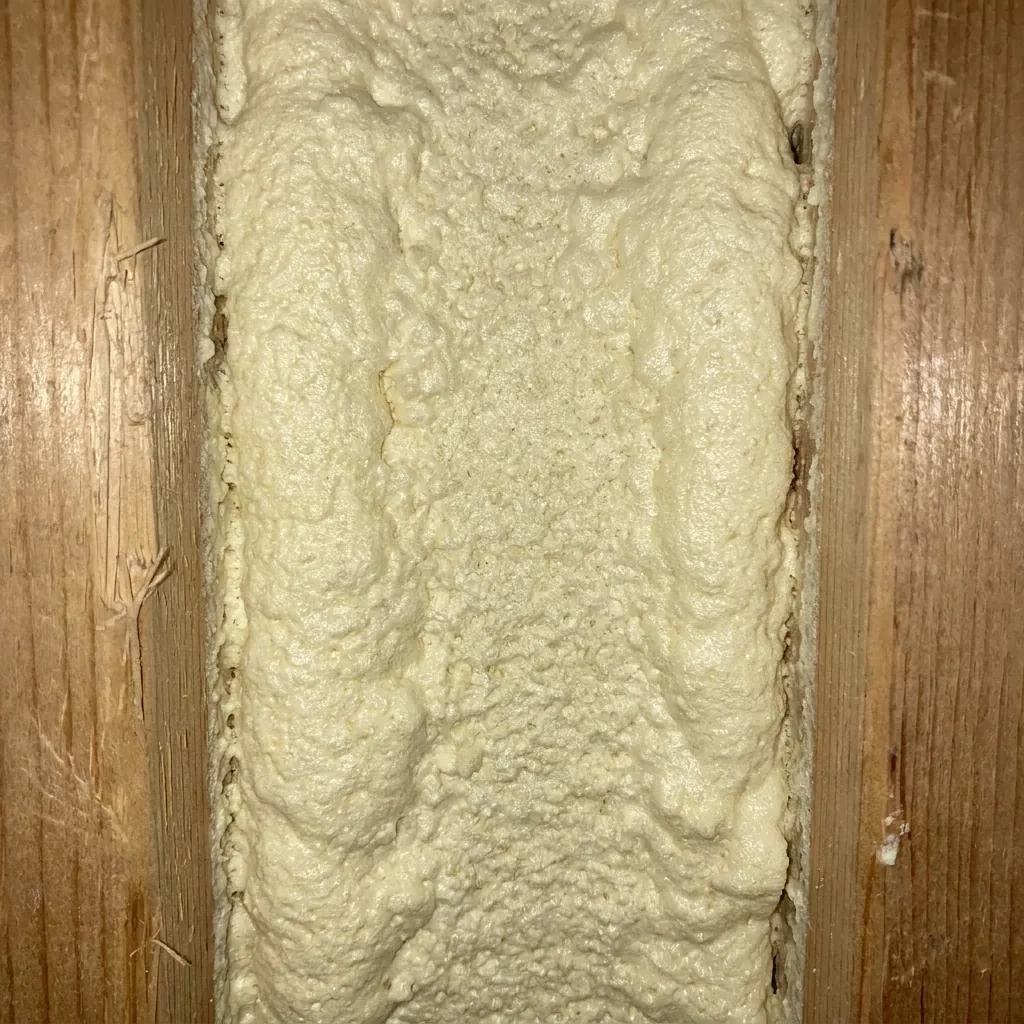
Same two-component polyurethane chemistry, sprayed from the same rig. What differs is what comes out of the gun: a soft, vapor-open sponge or a rigid, vapor-retarding plastic.
| Property | Open cell | Closed cell |
|---|---|---|
| Cured density | About 0.5 lb per cubic foot; soft, compresses under a thumb | About 2 lb per cubic foot (one current HFO product lists 2.0 to 2.4); rigid |
| Aged R-value per inch | About R-3.6 to R-3.8, R-3.7 typical | About R-6.5 to R-7; some HFO lines list up to R-7.4 depending on thickness |
| Vapor behavior | Vapor-open: double-digit perms at normal thickness (one manufacturer sheet lists 20.7 perms at 2 in.) | Class II vapor retarder, 1.0 perm or less, at about 1.5 to 2 in. depending on the product |
| Air barrier | Yes, at the thickness the manufacturer lists (3 in. on Huntsman’s Classic Ultra sheets) | Yes, at the thickness the manufacturer lists |
| Structure | Adds essentially no stiffness | Bonds to and stiffens sheathing, framing, and steel panels |
| Sound | Absorbs airborne noise well inside a cavity | Stops air leaks but absorbs less sound |
| Water | Soaks up and holds bulk water | On FEMA's list of flood damage-resistant materials |
| Blowing agent | Water (the reaction makes CO2) | HFO in current lines, replacing older high-GWP HFC blends |
| Installed price, 2026 national aggregator data | $0.44 to $0.65 per board foot | $1.00 to $1.50 per board foot |
A board foot is one square foot, one inch thick. Figures come from manufacturer data sheets (Huntsman Building Solutions open cell and Heatlok HFO High Lift), the Department of Energy's Building America spray foam guide, and FEMA Technical Bulletin 2; links are listed under the FAQ. Any specific job is specced off the data sheet of the product actually sprayed, and the estimate names it.
02 the vapor question
Closed Cell Spray Foam Insulation and Wisconsin's Vapor Retarder Rule
The biggest difference between the two foams in this part of the state is not R-value. It is what happens to indoor moisture in January. Eau Claire County sits in climate zone 6A on the ASHRAE map that energy codes use, with the state's northern tier in zone 7, and in that climate warm, damp house air spends five months pushing outward toward sheathing that sits far below its dew point. The model code answer, IRC Section R702.7, is a Class I or Class II vapor retarder on the interior side of frame walls in zones 5 through 8.
Wisconsin writes its own version into the Uniform Dwelling Code at SPS 322.38. Every frame wall, floor, and ceiling in the thermal envelope gets a vapor retarder on the warm-in-winter side, and the code defines a retarder by performance: 1.0 perm or less under ASTM E 96, Procedure A. Two exceptions matter here. No retarder is required in the box sill. And no retarder is required over a cavity where at least half the required R-value comes from spray foam rated at 1.0 perm or less, unless the foam's manufacturer says otherwise.
What SPS 322.38 Means for Each Spray Foam
Closed cell at roughly 1.5 to 2 inches, depending on the product, tests at or under 1.0 perm, so it is the vapor retarder. In a wall that needs R-20, 2 inches of closed cell supplies about R-14, comfortably over half, and clears the perm threshold on any product we spray, which is why 2 inches is the working spec you will see on our estimates. No poly sheet goes over it. Open cell never qualifies for that exception, because it is vapor-open at any practical thickness. An open cell wall is still a perfectly good wall; it just carries a separate warm-side retarder like any batt wall does, a sheet retarder or a rated vapor-retarder primer on the drywall where the inspector accepts one, and the estimate says which.
Open Cell Spray Foam on a Cold Roof Deck
The roof deck is where the vapor difference turns into rot or no rot. Foam the underside of the deck and the attic becomes unvented and conditioned, which the IRC allows under Section R806.5. In zones 5 through 8, that section requires the air-impermeable insulation against the deck to be a Class II vapor retarder itself, or to carry a vapor retarder coating or covering in direct contact with its underside. Closed cell at full thickness meets that as sprayed. Open cell does not, and without a retarder, indoor moisture diffuses through the foam all winter and collects in the sheathing, the coldest surface in the assembly.
Building Science Corporation's interior spray foam guidance goes further than the code minimum: in zone 5 and colder it recommends only high-density closed cell against the deck, and it notes that vapor retarder paints over open cell have had only limited success because the foam's rough surface is hard to coat evenly. That is our default too. On Eau Claire roof decks we spray closed cell, or a hybrid with enough closed cell against the deck to keep it above the dew point and open cell building the rest of the depth. Whether the deck is even the right place to insulate, versus the attic floor, is a separate decision covered on the attic insulation page.
03 roof to footing
Where Closed Cell and Open Cell Foam Go in a Chippewa Valley Building
Most houses here end up with both foams, each where it out-performs the other. This is the default map we start every walkthrough with; the building can overrule it.
| Assembly | Default foam | Why |
|---|---|---|
| Roof deck, unvented attic | Closed cell or hybrid | Class II at the deck as sprayed; open cell needs a coating detail that rarely holds up. Attic page |
| Attic floor, vented attic | Seal first | Foam seals top plates and chases; depth above that is cheapest in other materials (see below). |
| Framed 2x6 walls | Open cell | Fills the bay at about R-20 for the least money; warm-side retarder required. New construction |
| Framed 2x4 walls | Closed cell or either | Shallow bays favor R per inch; 3 in. of closed cell reaches about R-21. |
| Rim and band joist | Closed cell | Cold wood, air leaks, and condensation in one strip. Rim joist page |
| Basement walls | Closed cell | Bonds to concrete with no gap for room air to condense in. Basement page |
| Crawl space walls | Closed cell | Ground moisture and wetting events. Crawl space page |
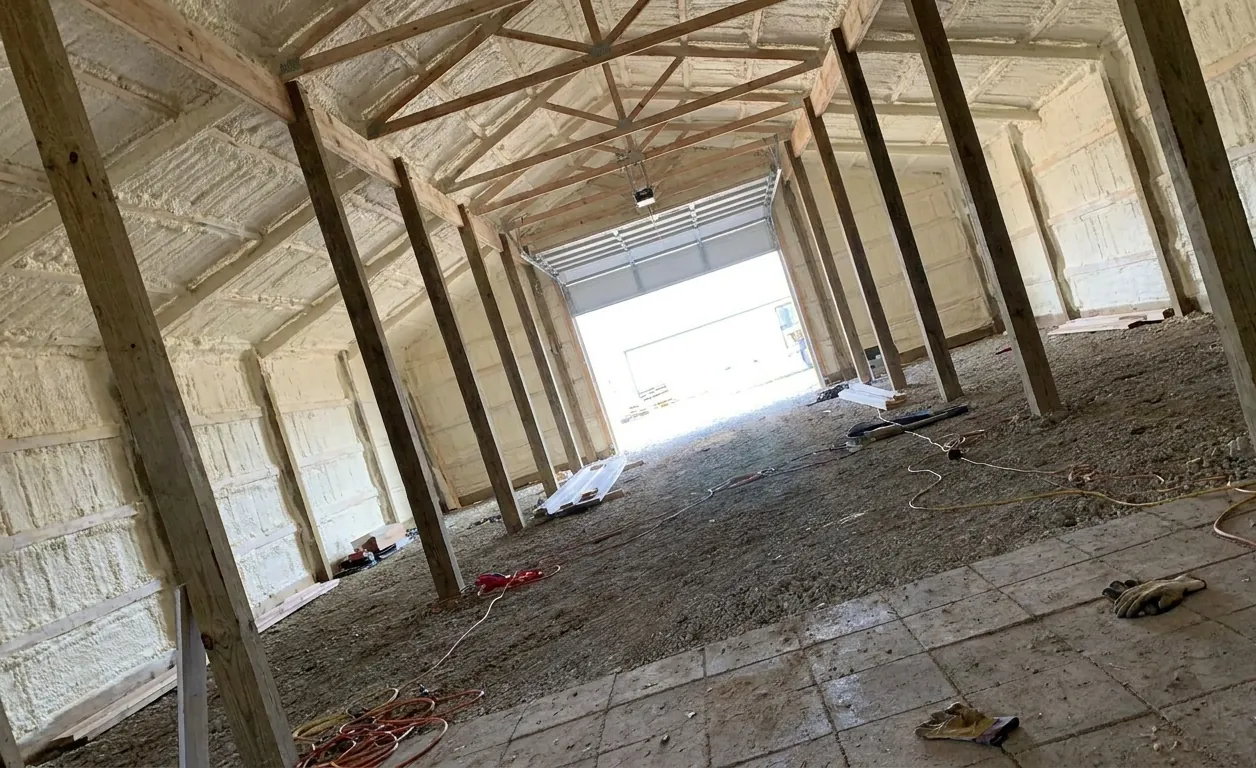
| Pole barn and steel panels | Closed cell | Steel is cold and vapor-tight; only a vapor-closed foam keeps it dry. Pole barn page |
| Garage walls, dry framing | Open cell | Warmth on a budget; closed cell under a bonus room floor. Garage page |
| Interior walls, sound only | Open cell | Absorbs airborne noise; no thermal job to pay a premium for. |
Rim Joists Get Closed Cell Foam Insulation
The rim is the one place we do not quote open cell as an option. The band joist is the coldest wood in the house, it sits against outdoor air on one side and basement humidity on the other, and a vapor-open foam lets that humidity reach the cold rim and condense against the wood. Two inches of closed cell, about R-14, bonds to rim and sill, seals the seam between them, and keeps the condensing surface inside the foam. SPS 322.38 exempts the box sill from a separate retarder, and closed cell would make one redundant anyway.
Roof Decks Take Either Foam, With a Vapor Plan
Both foams are allowed against a roof deck; only one is allowed bare in this climate. Open cell becomes legal in an Eau Claire unvented attic with a vapor retarder coating or covering on its interior face, and some builders accept that for its lower cost and sound damping under a metal roof. We will price it when asked, and we will put the coating, its tested perm rating, and who maintains it on the estimate in writing.
Pole Barn Steel Takes Closed Cell Only
A steel panel is a perfect vapor barrier on the wrong side of the insulation. Spray open cell against it and moist shop air passes straight through the foam to cold metal, condenses, and soaks the sponge you just paid for. Closed cell bonds to the panel, holds the interior surface near room temperature, and stiffens the skin in the same pass. That is the whole reason the pole barn insulation page specs closed cell without a second option.
04 the calls that cost us
Open Cell Spray Foam, Closed Cell, or Neither: Honest Calls
Where Closed Cell Insulation Is Overkill
Filling a 2x6 wall to full depth with closed cell buys about R-38 of foam where open cell gets about R-20 for well under half the board-foot price, and the wall's real loss paths, studs, plates, and windows, cap what that extra R can return. Closed cell earns its premium where depth is scarce or moisture and structure are in play; in a dry, deep, framed bay it is mostly a bigger invoice. The same goes for interior walls sprayed for sound: closed cell is the worse acoustic product at twice the price.
Where Open Cell Foam Is the Wrong Product
Anywhere it touches concrete, steel, or ground moisture: basement walls, crawl space walls, rim joists, metal buildings. Anywhere floodwater could reach it, since FEMA keeps it off the flood damage-resistant list. And on an unvented roof deck in this climate without a vapor retarder detail. A lower bid that puts open cell in those places is not the cheap version of the same job; it is a different job with a moisture problem written into it.
Where Neither Spray Foam Is the Best Buy
An empty, vented attic over a simple ceiling is the clearest case. Foam the top plates, chases, and penetrations to stop the air, and the depth above that is usually cheapest as a deep layer of loose-fill insulation, which is not something this crew installs, and we will say so on the walkthrough. Flash-and-batt walls, a thin closed cell lift against the sheathing with batts filling the rest of the bay, are another budget option we price when asked. And a basement nobody plans to use is often better served by a rim seal alone this year than by foamed walls.
05 the premium
What the Closed Cell Spray Foam Premium Buys
Board-Foot Cost of Each Spray Foam
National 2026 aggregator data puts open cell at $0.44 to $0.65 per installed board foot and closed cell at $1.00 to $1.50, so closed cell costs roughly twice as much per inch. Per unit of R-value the gap nearly closes: by our arithmetic on those same ranges, about 12 to 18 cents per R per square foot for open cell against 14 to 23 cents for closed cell. The premium is really paying for thinness, vapor control, strength, and water tolerance. If an assembly needs none of those, it should not pay for them.
Sound Damping in Open Cell Foam
Open cell's soft, connected cell structure absorbs airborne sound inside a cavity, which is why it goes in bedroom walls, home theaters, and the bays between a bathroom and a living room. It is not soundproofing: impact noise travels through framing either way, and doors and ducts carry more sound than any wall cavity. Closed cell quiets a room mostly by sealing air leaks.
Racking Strength From Closed Cell Foam
Cured at around 2 pounds per cubic foot, closed cell bonds sheathing, framing, and steel skins into a stiffer assembly. Pole barn owners notice it on the first windy day as panels that stop drumming. It does not replace bracing or engineering in a framed wall; it is a benefit, not a design value. Open cell adds essentially nothing structurally.
Flood Resistance and FEMA's Material List
FEMA's Technical Bulletin 2 sorts building materials by whether they survive prolonged contact with floodwater, and closed cell foam is on the acceptable side of that line while fibrous insulation and open cell foam are not. For houses along the Chippewa and Eau Claire river flats, and any basement with a sump history, that is a practical reason closed cell goes below grade even where the budget is tight.
HFO Blowing Agents in Closed Cell Foam
Open cell foam blows with water. Closed cell needs a blowing agent trapped in its cells, and the industry has moved from HFC-245fa blends to HFO agents; Arkema, one producer, puts its HFO's reduction in global warming potential at 99 percent against the legacy HFC. The closed cell we spray uses current HFO chemistry, and the data sheet goes in the job file.
06 code and cure
Thermal Barriers and Cure Time for Either Spray Foam
Both foams are foam plastics under IRC Section R316, and neither one is allowed exposed to living space. The standard thermal barrier is half-inch gypsum wallboard, which most finished walls and ceilings already include. Attics and crawl spaces entered only for repairs or maintenance can use an ignition barrier instead, from a code list that includes 1.5 inches of mineral fiber, quarter-inch wood structural panel, and 3/8-inch gypsum board, or an intumescent coating on a foam tested for that use. The barrier is the same question for open and closed cell, and the estimate names the treatment for each surface.
Cure and re-occupancy also run the same for both. The Consumer Product Safety Commission tells residents to stay out for at least 24 hours after two-component spray foam goes in, EPA points to the manufacturer's stated re-entry time for the specific product, and that time can run longer for sensitive occupants. Spray day gets scheduled around that window with ventilation running throughout.
07 asked often
Closed Cell and Open Cell Spray Foam FAQ
Is closed cell spray foam worth the extra cost?
Where an assembly needs vapor control, water tolerance, strength, or the most R-value in a thin space, yes: rim joists, basement and crawl space walls, steel buildings, and roof decks in this climate. In a deep, dry framed cavity, usually not. Open cell fills a 2x6 wall at about R-20 for roughly half the board-foot price, and per unit of R-value the two foams cost about the same.
Does a wall with closed cell foam still need a plastic vapor barrier in Wisconsin?
Usually not. Wisconsin's Uniform Dwelling Code, SPS 322.38, waives the separate vapor retarder over cavities where at least half the required R-value comes from spray foam rated at 1.0 perm or less, unless the manufacturer requires one. Two inches of closed cell meets both conditions in a standard R-20 wall. An open cell wall does not qualify and still needs a warm-side retarder.
Can open cell spray foam go on basement walls?
Not on our jobs. Concrete stays cold and wicks ground moisture, and open cell lets room air reach that cold surface and holds any water it gets. Closed cell bonds directly to block or poured walls, acts as its own vapor retarder, and is on FEMA's flood damage-resistant list. Below grade, open cell is the wrong product even when it is the cheaper bid.
Can closed cell and open cell be combined in one assembly?
Yes, and on Eau Claire roof decks it is often the best value: a closed cell layer sprayed directly against the deck for vapor control and condensation protection, then open cell building the remaining depth at lower cost. The closed cell layer has to be thick enough to keep the deck above the dew point, so its thickness is a written line on the estimate, not a guess made on spray day.
Does open cell spray foam rot roof decks?
Open cell does not rot anything by itself; uncontrolled moisture does. In a cold climate, open cell on an unvented roof deck without a vapor retarder lets indoor moisture diffuse to cold sheathing all winter, and that is how the reported failures happen. The IRC requires a Class II vapor retarder at the deck in climate zones 5 through 8, which closed cell provides as sprayed and open cell needs a coating or covering to meet.
How long before we can move back in after either foam is sprayed?
Plan on at least 24 hours for both foams, the minimum the Consumer Product Safety Commission advises for residents after two-component spray foam. The product manufacturer's written re-entry time governs the specific job, and households with infants, elderly members, or chemical sensitivities should allow longer. Ventilation runs through the cure window.
Sources: Wisconsin UDC, SPS 322; Insulation Institute on IRC R702.7; Building Science Corporation, IRC FAQ: Conditioned Attics; Building Science Corporation, BSI-116 Interior Spray Foam; DOE Building America spray foam guide; Huntsman Heatlok HFO High Lift; Huntsman Classic Plus open cell data sheet; Huntsman Classic Ultra open cell sell sheet; FEMA Technical Bulletin 2 (2025); Arkema on HFO-1233zd; CPSC spray foam guidance; EPA on re-entry time; OpenEI, Eau Claire County climate zone. Price ranges: 2026 national aggregator data, as published on the homepage rate table.
Get Both Foams Priced on One Estimate
Most estimates here price open and closed cell side by side wherever the assembly genuinely allows either, and name the foam, the inches, and the R target for every surface that does not. The walkthrough is free and takes about an hour: attic, walls, rim, and any outbuilding you want counted, with the vapor retarder and code barrier for each surface spelled out in the written number that follows. Call or text (715) 716-7940 to set it up, or see the full service list on the Eau Claire Spray Foam Pro homepage.
Rather talk it through?
(715) 716-7940call or text, photos welcome
Request your free estimate
Tell us about the space and we’ll get back to you with a time for the free walkthrough.