Guide · loose-fill attics in the Chippewa Valley
Blown-In Attic Insulation: Cellulose, Fiberglass, and Why Air Sealing Comes First
For a simple, vented attic over a flat ceiling, a deep layer of blown-in cellulose or fiberglass is usually the cheapest way to add R-value, and spray foam usually is not. The catch is that loose-fill slows heat but barely slows air, so the leaks in the ceiling have to be sealed before the first bag goes in. Get that order right and the cheap material does its job.
Who wrote this, and what we don't do. Eau Claire Spray Foam Pro sprays foam and air-seals attics. We do not blow cellulose, loose-fill fiberglass, or any other loose-fill, and nothing on this page is an offer to. We wrote it because loose-fill is often the right material for an attic floor, because the order of work is what usually goes wrong, and because a homeowner deciding between the two deserves the comparison from someone who will say when foam is the worse buy.
01 the materials
What Blown-In Insulation Is: Cellulose, Fiberglass, and Mineral Wool
Blown-in insulation, also sold as loose-fill, is fiber that arrives compressed in bags and gets fluffed through a blowing machine and a long hose onto the attic floor, where it settles into a continuous blanket over the ceiling joists, the wiring, and every odd-shaped bay a batt would leave gaps in. Three fibers are sold this way. They differ in what they are made of, how much R-value each inch carries, and how much they settle after the installer leaves.
Cellulose Insulation: Recycled Paper With a Fire Retardant
Cellulose is shredded paper fiber. The Cellulose Insulation Manufacturers Association describes it as up to 85 percent recycled paper and cardboard, and all of it is treated with fire retardants; boric acid is the common one, used both as a flame retardant and to repel insects, and some products, such as GreenFiber's INS765LD, are sold as all-borate formulas. The Department of Energy's Building America program lists loose-fill cellulose at a settled density of 1.5 to 2.0 pounds per cubic foot and a settled R-value of about R-3.2 to R-3.8 per inch. That density is the source of most of its strengths: it is heavier and tighter than blown fiberglass, so more of it is needed by weight, and it does more to slow air moving through the layer.
Blown Fiberglass Insulation
Loose-fill fiberglass is glass fiber made for blowing rather than rolling into batts. The same DOE source lists it at 0.5 to 1.0 pounds per cubic foot and about R-2.2 to R-2.7 per inch, so an attic needs more inches of fiberglass than of cellulose to reach the same R-value. It does not absorb moisture under the ASTM test cited on Owens Corning's AttiCat data sheet, and it settles very little, which is why fiberglass coverage charts list a minimum thickness that equals the settled thickness.
Loose-Fill Mineral Wool
Rock or slag wool blown as loose-fill runs denser than fiberglass, about 1.7 pounds per cubic foot settled and R-3.0 to R-3.3 per inch by the DOE figures, and it settles about as little as fiberglass. If a bid offers it, hold it to the same paperwork as the others: a product name and a coverage chart.
Installed Depth, Settled Depth, and the Coverage Chart
Loose-fill is sold by the bag, and its R-value depends on how much material lands per square foot, not on how tall the fluff looks on install day. That is why the Federal Trade Commission's R-value rule, 16 CFR 460.12, makes every loose-fill bag carry a coverage chart giving, for each R-value, the minimum settled thickness, the initial installed thickness, the maximum net coverage area, the number of bags per 1,000 square feet, and the minimum weight per square foot. The bag count is the honest check. A blowing machine can fluff a thin, light layer to the right height; it cannot fake the number of empty bags.
Cellulose is blown deeper than its target because it settles. DOE puts loose-fill cellulose settling at 10 to 20 percent over time; CIMA's installation bulletin puts applied thickness 5 to 12 percent above settled thickness, and the gap is built into every chart. On GreenFiber's INS765LD chart, R-49 calls for at least 56.6 bags per 1,000 square feet, blown to 14.78 inches so it settles to 13.30. Blown fiberglass settles only 2 to 4 percent, so Owens Corning's AttiCat chart lists R-49 at 25 bags per 1,000 square feet and 17 inches, with the same 17 inches as the settled figure. Neither number means much on its own. Together, bags and depth tell you whether the attic actually got the R-value on the invoice.
02 side by side
Blown-In Cellulose vs Fiberglass in a Cold Attic
Both loose-fills are legitimate attic-floor products, and either one, blown to its chart over a sealed ceiling, will do the job. Foam is in the last column because it is the thing people usually compare them against, and the comparison is not close on price.
| Property | Blown-in cellulose | Blown-in fiberglass | Spray foam (for contrast) |
|---|---|---|---|
| Made from | Up to 85% recycled paper and cardboard, fire-retardant treated | Glass fiber made for blowing | Two-component polyurethane sprayed in place |
| R-value per inch | About R-3.2 to R-3.8 settled | About R-2.2 to R-2.7 settled | About R-3.7 open cell, R-6.5 to R-7 closed cell, aged |
| Settled density | 1.5 to 2.0 lb per cubic foot | 0.5 to 1.0 lb per cubic foot | Not applicable |
| Settling | 10 to 20% over time; charts blow it deeper to compensate | 2 to 4% over time | None |
| Example chart depth, R-49 | 14.78 in. installed, 13.30 in. settled, 56.6 bags per 1,000 sq ft (GreenFiber INS765LD) | 17 in. installed and settled, 25 bags per 1,000 sq ft (Owens Corning AttiCat) | About 7 in. of closed cell |
| Air movement | Slows airflow better than fiberglass, but not an air barrier | Slows airflow less than cellulose; not an air barrier | Air barrier at the manufacturer's listed thickness |
| Water | Absorbs and stores moisture, then gives it back | Does not absorb moisture per its maker's ASTM test | Open cell holds water; closed cell resists it |
| Extreme cold | Held its R-value in Oak Ridge cold-attic tests | Low-density layers lost R-value to convection in deep cold in the same era of tests | Air-impermeable, so no air circulates within it |
| Best use in an attic | Deep layer on a sealed, vented attic floor | Deep layer on a sealed, vented attic floor | Roof deck, ducts in the attic, complex or shallow roofs |
| National installed price | $1.20 to $2.80 per sq ft (HomeGuide) | $1.00 to $2.80 per sq ft (HomeGuide) | Several times loose-fill per unit of R |
Loose-fill R-values, densities, and settling are DOE Building America figures; chart depths and bag counts come from the named manufacturers' coverage charts; foam R-values are the aged figures on our open vs closed cell comparison. Prices are 2025 national averages from HomeGuide, not this business's prices; we do not install loose-fill and do not price it. The foam price cell is our own arithmetic on published national ranges. Links are under the FAQ.
Air Flow and Wind Washing at the Eaves
Neither loose-fill is an air barrier. Building Science Corporation, which has studied cellulose about as closely as anyone, puts it plainly: cellulose is significantly more airtight than other common cavity fills, but its thermal performance still depends on separate air sealing. Fiberglass is more open still. The place this matters most is the eave, where outdoor air enters through the soffit vents and can blow across or through the edge of the insulation. Building scientists call it wind washing, and it strips R-value from exactly the strip of ceiling over the exterior walls that is already the thinnest. The fix is mechanical, not material: a baffle that keeps the vent air above the insulation, covered under prep below.
Cold-Weather Convection in Loose-Fill Fiberglass
Light, open loose-fill fiberglass has a documented cold-weather weakness. In Oak Ridge National Laboratory attic tests reported in 1991, a low-density loose-fill fiberglass attic lost roughly 40 to 50 percent of its effective R-value at extreme cold, as air began circulating within the layer, while loose-fill cellulose in comparable testing held or slightly gained R-value as the attic dropped below zero. Owens Corning's current AttiCat data sheet acknowledges the effect, saying convection in loose-fill fiberglass in open attics can reduce thermal performance at extreme winter temperatures. The fiberglass industry's position is that it occurs when the product is installed too light, which is one more reason to count bags. In a Chippewa Valley attic, where the record low is 45 below zero, that is a real point in cellulose's favor, not a dealbreaker for properly installed fiberglass.
Moisture, Roof Leaks, and Loose-Fill
Cellulose is hygroscopic: it takes moisture in and lets it back out, and Building Science Corporation has written that it can store a lot of water safely. Its borate treatment helps it resist mold. Fiberglass takes on essentially no water itself, so water passes through it to whatever is below. Neither one forgives a roof leak, a bath fan blowing into the attic, or a winter of warm air pouring up through an unsealed ceiling; those are moisture sources, and the insulation choice does not fix them. ENERGY STAR lists wet or damp insulation as a sign of a roof leak that needs a contractor before more insulation goes in.
03 the order of work
Air Sealing Comes Before Blown-In Attic Insulation
ENERGY STAR's attic guidance says it in one sentence: EPA recommends air sealing the attic before adding attic insulation. DOE's insulation guide for homeowners is blunter: most insulation does not stop airflow, money spent on insulation can be wasted if the holes and gaps are not sealed first, and adding insulation without air sealing risks serious moisture problems. Loose-fill is the clearest case. Blow 14 inches of it over a leaky ceiling and the warm air keeps rising through it, carrying heat and household moisture into the attic just as it did before, only now through a layer that hides every leak from the next person who looks.
- Soffit vent: outdoor air enters under the overhang.
- Eave baffle keeps a vent channel open above the insulation.
- Top plate of the exterior wall, sealed where it meets the ceiling.
- Ceiling box or light: sealed, and IC-rated if insulation will touch it.
- Plumbing stack through the interior top plate, gap sealed.
- Loose-fill blown to the coverage chart over the sealed ceiling.
- Depth marker: installed line above, settled line below.
- The eave pinch: least depth over the exterior wall, where frost and ice dams start.
Attic Air Leaks Loose-Fill Can't Stop
ENERGY STAR's do-it-yourself guide tells homeowners to plug the big holes first: where inner and outer walls meet the attic floor, dropped soffits, and the spaces behind and under kneewalls. Then the smaller ones: plumbing vent pipes, wiring holes drilled through top plates, furnace flue and duct chases, recessed lights, and the attic hatch itself, which the guide says to treat like a door to the outside. Caulk handles gaps up to about a quarter inch and expanding foam handles larger ones, up to about three inches. The one exception is the gap around a chimney or metal flue, which ENERGY STAR says to close with aluminum flashing and high-temperature caulk, not spray foam.
Older Eau Claire houses carry more of these leaks than the guide's diagram shows. The balloon-framed houses around the Third Ward and Randall Park have wall cavities that run open from the basement to the attic like flues, and every one of those bays is an air path that loose-fill sitting on top will not close.
Attic Frost and Ice Dams in a Climate Zone 6 Winter
Eau Claire County sits in IECC climate zone 6A, and the city logs 7,923 heating degree days in a normal year, measured at Chippewa Valley Regional Airport. In that climate, air leaking up through the ceiling is not just lost heat. DOE notes that some of the moisture in a house, from cooking, bathing, and breathing, ends up in the attic by that route, where it meets roof sheathing that sits far below freezing for months and can condense or frost on roof sheathing that sits below freezing for months. The same leaking warmth melts snow from below and feeds ice dams at the eaves; ENERGY STAR counts a history of ice dams as a sign of serious air leaks. Our attic insulation page covers why ice dams end at the ceiling plane. A thicker loose-fill layer helps; sealing the leaks is what removes the heat source.
Who Does the Attic Air Sealing
Some loose-fill installers air-seal as part of the job and price it in, some sell it as a separate line, and some leave it out. Ask which, in writing. Air-sealing the attic floor plane with foam is work this crew does, top plates, chases, and penetrations, on the floor approach described on the attic insulation page. When the honest plan is foam to seal and loose-fill to build the depth, we can do the sealing and you hire a loose-fill installer for the depth, and we will tell you that on the walkthrough rather than quote foam for the whole attic.
04 the decision
Blown-In Insulation, Spray Foam, or Both?
Most attics sort themselves into one of three answers. Find the column that describes yours; if two fit, the one with more checks usually wins.
Answer A
Loose-fill on the attic floor
- Vented attic over a flat ceiling, simple gable or hip roof
- No ductwork, air handler, or living space in the attic
- Room for full depth over most of the floor, with baffles at the eaves
- Leaks are ordinary: plates, wires, pipes, hatch, a chase or two
- Budget matters more than squeezing out the last R
Who does it: an insulation contractor who blows cellulose or fiberglass, with air sealing in the bid. Not us.
Answer B
Foam seals the floor, loose-fill builds the depth
- Same simple vented attic as Answer A
- But the leaks are big: balloon-frame bays, open chases, dropped soffits
- Or more top plates and penetrations than a caulk gun can handle well
- Frost on the nails or ice dams in past winters
Who does it: foam air sealing first (we do this part), then a loose-fill installer blows the depth.
Answer C
Foam on the roof deck
- Ducts or an air handler live in the attic
- Cathedral sections, kneewalls, or a complex roof with little floor to fill
- Low-slope eaves with almost no depth possible over the top plate
- Ice dams that keep coming back at a shallow eave
- Plans to use the attic for storage or a finished room
Who does it: a spray foam crew. See the attic insulation page and the foam type comparison.
When Loose-Fill on the Attic Floor Is the Better Buy
This is the admission that costs us work. For a plain vented attic over a ranch or a two-story with an empty attic and a simple roof, sealing the ceiling and blowing loose-fill to the chart gets the R-value for a fraction of what foam would cost. HomeGuide's national figures put blown-in attic work at $0.90 to $2.40 per square foot; reaching the same R-value with closed cell on the floor or the deck takes about 7 inches of foam at a board-foot price that multiplies quickly. Foam on the floor of a simple attic is usually money spent on a material advantage the attic does not need. If that is your attic, have the leaks sealed and hire someone who blows loose-fill.
When Roof-Deck Foam Beats Loose-Fill
Loose-fill only works on a floor it can lie on. It cannot follow a cathedral ceiling, it does nothing for ductwork running through a cold attic, and at a low-slope eave there may be only a few inches between the top plate and the roof deck, no matter how much goes on the rest of the floor. Wisconsin's own dwelling code recognizes that edge: SPS 322.32 lets R-38 satisfy the new-home ceiling requirement where the full uncompressed depth extends over the wall top plate at the eaves. When the eave cannot get that depth, or the attic holds mechanicals, foaming the underside of the roof deck moves the whole attic inside the envelope. That is spray foam work, and it is ours; the deck-versus-floor call is laid out on the attic insulation page, and the foam type matters there too, since in this climate open cell on a roof deck needs a vapor retarder that closed cell carries built in.
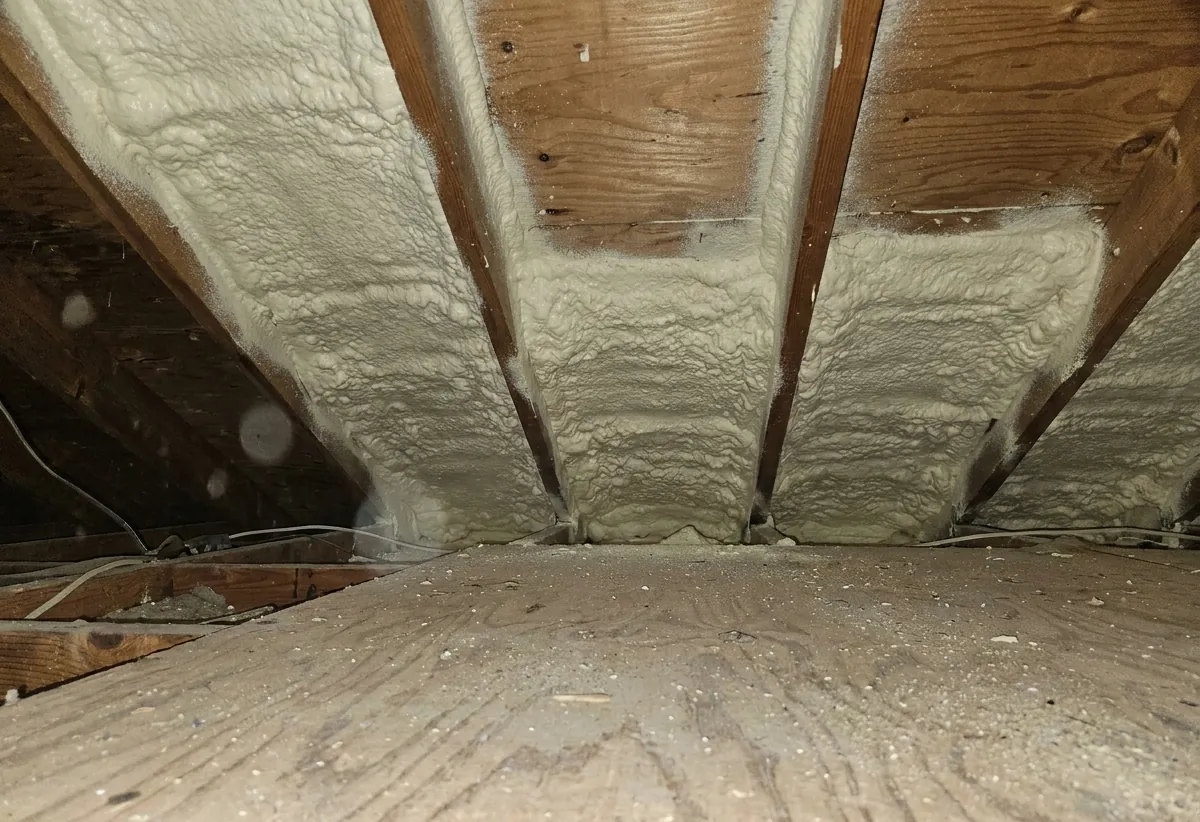
Foam Air Sealing Plus a Loose-Fill Layer
The hybrid in the middle column fits a lot of older Chippewa Valley housing, where balloon-frame bays and chases make the leaks too big for a caulk gun, and it is just the right order of work done by two trades. Foam closes the openings that caulk and board handle poorly, the open tops of balloon-frame bays and the gaps around chases and dropped soffits, and the loose-fill installer comes in afterward with baffles, hatch dam, and bags. The one thing to settle in advance is who owns each item on the prep list below, so nothing falls between the two bids.
05 before the hose comes up
Prep Work a Blown-In Insulation Job Needs
The material is the easy part. What separates a good loose-fill job from a pile of fluff over problems is the prep, and most of it is spelled out in code or federal guidance.
Eave Baffles and Open Soffit Vents
ENERGY STAR's guide puts it in capitals: never cover attic soffit vents with insulation; use rafter vents, also called insulation baffles, to keep the air moving. The model energy code, IECC R402.2.3, requires a baffle next to soffit and eave vents for air-permeable insulation in vented attics, holding an opening at least as large as the vent and extending above the top of the insulation, and the IRC wants at least a 1-inch space between insulation and roof sheathing at the vent. Wisconsin's dwelling code says simply that insulation shall not block the free flow of air. A baffle at every vented rafter bay belongs in the bid, and so does a block at the outer edge of the top plate so the blowing hose does not fill the soffit itself.
Attic Hatch Dams and Weatherstripping
An attic hatch is a hole in the ceiling with a lid on it. Wisconsin's UDC, SPS 322.32, requires the access cover in an unconditioned attic to be weatherstripped and insulated to match the surrounding ceiling, and where loose-fill is installed, a wood-framed baffle or retainer around the opening so insulation does not spill into the house when the hatch opens and the R-value around the opening holds. That rule governs new homes; a retrofit bid should meet it anyway.
Chimney, Flue, and Recessed Light Clearances
DOE's guide notes that cellulose must be kept away from chimneys and metal flues. ENERGY STAR describes the usual building code clearance as 1 inch from metal flues and 2 inches from masonry chimneys to any combustible, including insulation, with a sheet-metal dam to hold loose-fill back. Recessed can lights are the other hazard: ENERGY STAR says to keep all insulation at least 3 inches away unless the fixture is rated IC for insulation contact, and the electrical code says the same for non-IC fixtures. ENERGY STAR recommends IC-rated, airtight (ICAT) fixtures, which insulation can touch; an older non-IC can needs a dam that holds the insulation back, or replacement by an electrician.
Knob-and-Tube Wiring in Older Attics
The Chippewa Valley's lumber-era houses, in Eau Claire and Chippewa Falls alike, date from the knob-and-tube years, so an attic in one of them is worth checking before anything is blown in: porcelain knobs and separated single wires are pre-1930 electrical work. DOE's guide explains that insulation can make the wiring overheat, and ENERGY STAR calls it a fire hazard when in contact with insulation, and DOE's guide says not to proceed with air sealing or insulating where active knob-and-tube is found in the attic; the house must be rewired first. An electrician decides whether it is live. A loose-fill bid should not just blow over it.
Bath Fans That Dump Into the Attic
Bath and kitchen fans that end at the attic floor, or at a duct lying loose near the soffit, blow moist air straight into the coldest part of the house. The IRC, at M1501.1, says exhaust air goes to the outdoors and not into an attic, soffit, ridge vent, or crawl space, and ENERGY STAR lists fans exhausting into the attic as a problem for a contractor to fix. Get every fan ducted outdoors before it disappears under a foot of insulation.
Existing Insulation, Wet Spots, and Vermiculite
Dry, clean old insulation, batts or loose-fill, can usually stay, and new loose-fill goes on top; the existing layer counts toward the target, and ENERGY STAR's recommendation for zones 6 and 7 is R-49 for an attic that already has 3 to 4 inches and R-60 for an uninsulated one. Air sealing still comes first, which may mean pulling back old insulation to reach the plates. Wet, matted, moldy, or rodent-fouled material comes out, and the leak or entry point gets fixed before replacement. Vermiculite is different: a pebbly, gray-brown or silver-gold pour-in fill, much of it mined near Libby, Montana, and sold as Zonolite. EPA's advice is to assume it contains asbestos and not disturb it, and ENERGY STAR says not to disturb it unless an approved lab has tested it. No one should blow new insulation over vermiculite, vacuum it out, or crawl through it to air-seal until that question is answered by a professional.
06 the money
Blown-In Insulation Cost: National Ranges and What Moves Them
These are published national averages, not our prices; Eau Claire Spray Foam Pro does not install or price loose-fill. HomeGuide's blown-in insulation guide, updated November 2025, puts blown-in attic insulation at $0.90 to $2.40 per square foot, or $900 to $3,600 for a typical job, and its January 2026 attic guide puts loose-fill at $1.00 to $2.50 per square foot installed. HomeAdvisor's blown-in insulation cost guide lists a normal project range of $987 to $2,335. HomeGuide also notes that some companies carry a $1,500 to $2,000 minimum project.
Cellulose vs Fiberglass Price per Square Foot
Installed, the two land close together: HomeGuide lists blown-in cellulose at $1.20 to $2.80 per square foot and blown-in fiberglass at $1.00 to $2.80. Cellulose usually takes fewer inches to reach a given R-value but more pounds; fiberglass takes more inches and fewer bags. Compare bids on bags and settled R-value, not on inches.
Line Items Beyond the Loose-Fill
- Air sealing: $350 to $3,000 for an attic, per HomeGuide, depending on ductwork, gaps, and ceiling fixtures; some contractors include it, many list it separately.
- Old insulation removal: $1 to $2 per square foot (HomeGuide), only where the existing layer is wet, contaminated, or in the way of sealing.
- Baffles: $2 to $3 each at the soffit vents (HomeGuide); cheap per bay and not optional.
- Hazards: asbestos testing and abatement, rewiring knob-and-tube, and roof or bath fan repairs are separate trades with separate prices, and they come before the insulation.
- Depth and area: square footage times the chart's bags per 1,000 square feet at your target R-value is most of the material line.
- Access: a small scuttle hatch, low roof pitch, and crowded framing all add labor.
For what foam on the deck or floor runs instead, the cost calculator carries national planning ranges for both attic approaches.
07 hiring it out
Hiring a Blown-In Insulation Contractor Around Eau Claire
If you are searching for blown-in insulation near you in the Chippewa Valley, you want an insulation contractor who blows loose-fill as a regular part of the business, not a sideline. We are not that contractor, and we will not recommend one by name here. What we can do is tell you what a bid that deserves your signature looks like, because the bid is where most of a loose-fill job's quality gets decided. Get at least two written bids and compare them line by line.
What a Good Blown-In Bid States
- Material and product name: cellulose or fiberglass, and the specific product, so you can pull its coverage chart.
- Target R-value at settled thickness, for the whole attic floor, counting any existing layer that stays.
- Initial installed and minimum settled thickness, copied from the manufacturer's coverage chart.
- Bag count for your measured square footage, from the chart's bags per 1,000 square feet.
- Air sealing scope: which top plates, chases, penetrations, and fixtures get sealed, with what, or a plain statement that none is included.
- Baffles at every vented rafter bay, and blocking so the soffits stay clear.
- Attic hatch: weatherstripped, insulated, and a dam around the opening.
- Clearances: metal dam at chimneys and flues, and how each recessed light is handled.
- Existing insulation: stays, gets removed, or gets tested, and who checks for vermiculite and knob-and-tube.
- Bath and kitchen fans confirmed ducted outdoors, or listed as a separate fix.
- Depth markers and a signed certificate left at the job, as described below.
Questions to Ask a Loose-Fill Installer
- Is air sealing in this price, and can you show me on the attic floor what gets sealed?
- How many bags will go in, and will you leave the empty bags or a bag count I can check against the chart?
- What will the depth be on install day, and what will it settle to?
- How do you handle the eaves where the roof comes down low over the top plates?
- What do you do about the can lights, the flue, and the hatch?
- If you find knob-and-tube, vermiculite, a wet spot, or a fan venting into the attic, what happens to the schedule and the price?
The Attic Card and Depth Markers at the Hatch
Federal law already requires part of this. Under the FTC's R-value rule, 16 CFR 460.17, an installer must give the customer a contract or receipt, and for loose-fill it must show the coverage area, initial installed thickness, minimum settled thickness, R-value, and number of bags used. Wisconsin's dwelling code goes further for new homes: SPS 322.20 requires depth markers in blown-in attics, at least one per 300 square feet, fixed to the trusses or joists, showing both the minimum initial installed thickness and the minimum settled thickness in numbers at least an inch tall, each facing the attic access, plus a permanent insulation certificate posted at or next to the electrical panel. The IECC adds a signed, dated installer certificate listing installed density and bag count. On a retrofit, ask for all of it. A ruler you can read from the hatch, and a card that matches the bag count, is what lets you check the job without hiring anyone to climb up there.
08 asked often
Blown-In and Cellulose Insulation FAQ
Is blown-in cellulose better than blown-in fiberglass?
For a cold attic, cellulose has a modest edge: more R-value per inch, better resistance to air moving through the layer, and no loss of R-value in deep cold in Oak Ridge testing, where low-density fiberglass did lose some. Fiberglass settles less, absorbs no water, and is lighter on the ceiling. Either one, blown to its coverage chart over a sealed ceiling with baffles at the eaves, does the job; installation quality matters more than the fiber.
Why is cellulose blown deeper than the depth on the chart?
Because it settles. DOE puts loose-fill cellulose settling at 10 to 20 percent over time, so manufacturers list an initial installed thickness above the settled thickness the R-value is based on. On one common cellulose chart, R-49 is blown to 14.78 inches to settle at 13.30. Fiberglass settles only 2 to 4 percent, and its charts list the same figure for both.
Does blown-in insulation stop air leaks?
No. Cellulose slows air better than fiberglass, but neither is an air barrier, and DOE says plainly that most insulation does not stop airflow. Warm air rising through ceiling gaps passes through loose-fill and carries heat and moisture into the attic. That is why EPA and ENERGY STAR say to air-seal the attic floor before adding insulation.
Can loose-fill go on top of the old insulation in the attic?
Usually, if the old layer is dry, clean, and free of rodent damage, and once the ceiling has been air-sealed. Wet, moldy, or contaminated insulation comes out first. Vermiculite is the exception to everything: EPA says to assume it contains asbestos and leave it undisturbed, so nothing gets blown over it or pulled out until a professional has dealt with it.
Is cellulose insulation a fire risk?
The Cellulose Insulation Manufacturers Association says all cellulose insulation is treated with fire retardants, commonly boric acid. The real fire risks are clearances: DOE says to keep cellulose away from chimneys and metal flues, ENERGY STAR calls for 3 inches of clearance around recessed lights not rated IC, and active knob-and-tube wiring has to be replaced before any insulation covers it.
Does Eau Claire Spray Foam Pro install blown-in insulation?
No. We spray foam and air-seal attics; we do not blow cellulose, fiberglass, or mineral wool. If your attic is a loose-fill attic, we will say so and you should hire an insulation contractor who blows it. Where the ceiling needs foam air sealing first, or the attic is a roof-deck job, that part is work we do.
Sources:
- DOE Building America Solution Center, loose-fill insulation (density, settled R per inch, settling)
- DOE Building America, Energy Renovations: Insulation, a homeowner guide (air sealing first, moisture, knob-and-tube, flues)
- ENERGY STAR attic insulation project and DIY Guide to Sealing and Insulating
- ENERGY STAR recommended insulation levels
- EPA on asbestos-contaminated vermiculite insulation
- 16 CFR 460.12 and 16 CFR 460.17, FTC R-value rule
- Wisconsin UDC, SPS 322 (322.20 markers and certificate, 322.32 attic access, 322.39 ventilation)
- IECC 2021 R402.2.3 eave baffles; IRC R806.3 vent clearance; IRC M1501.1 exhaust
- Cellulose Insulation Manufacturers Association and its installation bulletin
- GreenFiber INS765LD coverage chart; Owens Corning AttiCat data sheet
- Building Science Corporation, building materials property table; BSI-043, Don't Be Dense
- Energy Design Update, 1991, on Oak Ridge cold-attic loose-fill tests
- DOE climate zones by county (Eau Claire County, 6A)
- Costs: HomeGuide blown-in, HomeGuide attic, HomeAdvisor blown-in; national averages, not this business's prices.
Air Sealing, Foam, or Just More Loose-Fill?
Not sure which one your attic needs? Call or text (715) 716-7940 and we will tell you honestly, even when the answer isn't us. If it is a loose-fill attic, we will say so and you can take this page's checklist to a contractor who blows it. If the ceiling needs foam air sealing first, or the attic belongs to the roof-deck column, that is the work we do, and the walkthrough is free. Photos of the attic floor, the hatch, and the eaves by text are a good place to start. More on what we do lives on the attic insulation page and the Eau Claire Spray Foam Pro homepage.
Rather talk it through?
(715) 716-7940call or text, attic photos welcome