Spray Foam Roofing: Spray-On SPF Roof Systems vs Foam Under the Deck
Every flat-roofed farm shop, low-slope steel building, and old commercial roof in the Chippewa Valley gets the same suggestion eventually: just spray foam it. That can mean two jobs that share a rig and almost nothing else. Which one your building needs depends on where the foam goes.
Foam above the deck
An SPF roof system
Roofing-grade foam is sprayed on top of the deck or the old roof, sloped to drain, and covered with an elastomeric coating. The foam and coating become the roof: they shed rain and snowmelt, and they are what leaks or doesn't.
Whose job: a roofing contractor who installs SPF roofs.
Foam below the deck
Interior foam on the underside
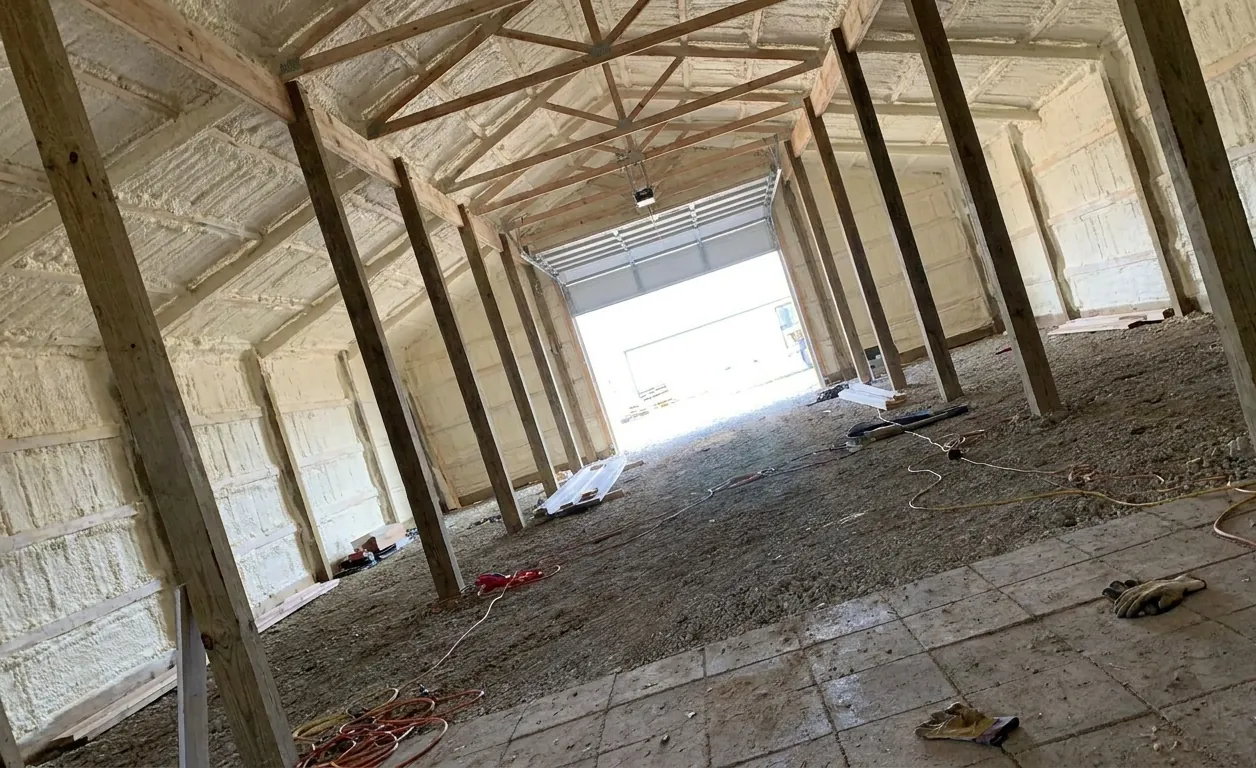
Foam is sprayed on the inside face of metal roof panels or an attic roof deck. It insulates and air-seals from inside. The roof above stays the roof, leaks included, and still sheds the weather on its own.
Whose job: a spray foam insulation crew. This one is ours.
What this page is. Eau Claire Spray Foam Pro sprays foam on the inside of roofs. We do not install SPF roof systems, apply roof coatings, re-cover roofs, or repair roof leaks, and nothing here is an offer to. We wrote this guide because owners keep asking us for a roof when they need insulation, and for insulation when they need a roof.
01 the assembly
What a Spray Foam Roofing System Is, Layer by Layer
A spray polyurethane foam roof, SPF roof for short, is a roof covering built in place from two liquids. Foam is sprayed onto a prepared deck or an existing roof, where it expands and cures into a seamless, rigid layer that is insulation and roof body at once. That foam cannot take sunlight, so a liquid-applied protective coating goes over it the same day, and that coating is the surface that meets the weather. Granules broadcast into the top coat are common. There is no membrane, no seams, and no mechanical fasteners through the field of the roof.
The building code treats it as its own roof type. Under the 2021 International Building Code, which Wisconsin adopted for commercial buildings effective September 1, 2025, Section 1507.13 requires an SPF roof to have a design slope of at least a quarter inch per foot, foam meeting ASTM C1029 Type III or IV or ASTM D7425, installation per the manufacturer's instructions, and a protective coating applied no sooner than 2 hours and no later than 72 hours after the foam.
Roofing-Grade SPF: Density, Compressive Strength, Aged R-Value
Roofing foam is a stiffer, heavier closed cell foam than the foam sprayed on the inside of a wall. Two roofing products' data sheets show the range. Carlisle's PremiSeal 285 is a nominal 2.8 pound per cubic foot roofing foam with 50 to 60 psi compressive strength and an R-value of 6.4 per inch. Huntsman's UltraLok 2.8 lists a core density of 2.7 to 2.9 pounds, 40 to 45 psi, and an aged R-value of 6.2 per inch. The compressive strength is what lets it carry foot traffic and snow without denting. The federal guide specification for SPF roofing, UFGS 07 57 13, sizes thickness on a more conservative aged R-5.6 per inch. Ask which number a bid uses.
The SPF Roof Coating Is the Weather Surface
Unprotected foam discolors and degrades in sunlight, which is why Carlisle's sheet calls for the coating the same day or within 24 hours and the federal spec says not to leave foam uncoated overnight. The coating keeps UV off the foam, takes the abrasion, and is the part that wears. It is maintained and periodically recoated for the life of the roof. Coatings get their own section below because the coating choice drives most of the long-term cost.
Where an SPF Roof Fits and Where It Doesn't
- Good fits: low-slope commercial roofs, flat-roofed shops and farm buildings, re-covers over sound metal, built-up, or single-ply roofs, and roofs with ponding that sprayed foam can be built up to drain, where the bid allows tapering.
- Poor fits: steep residential roofs that take shingles, roofs with wet or rotted substrate that has not been removed, roofs that already carry two coverings, and roofs that will see daily traffic unless walkways are designed in.
- Honest trade-offs: seamless, adhered, and insulating, with no tear-off in many cases. In exchange it needs more inspection and recoating than most roof types; the federal spec says so outright. It also has a tight weather window for installation, which matters here.
02 spray day on top
How Spray On Roofing Is Installed
An SPF roof is mixed and made on site, so most of its quality is decided by prep and conditions before and during the spray, not by the materials list. Here is what the job looks like from the roofing side.
Moisture Survey and Core Cuts Before a Re-Cover
Foam sprayed over a wet roof seals the water in. Before a re-cover, the existing roof gets surveyed for trapped moisture, often with an infrared scan or moisture meters. NRCA's Professional Roofing makes the point that infrared imagers do not see moisture, only temperature differences, and that non-destructive tools complement but do not replace invasive verification: cores cut from the roof and checked. Wet areas are cut out and replaced before foaming. Florida's SPF application standard, RAS 109, requires areas to be examined and tested for moisture immediately before foam goes on. If a bid prices a re-cover without a survey or core cuts, it is guessing about what is under the foam.
Building Slope With Sprayed Roofing Foam
Ponding water is the slow enemy of any low-slope roof, and SPF's party trick is that it can be sprayed thicker in some places than others. SPFA's executive director, writing in Buildings magazine, put the rule simply: slope must be added to provide positive drainage. Florida's RAS 109 sets a minimum of 1/4 inch per foot and says foam is to be applied to eliminate ponding, defining ponding as 100 square feet or more holding half an inch of water 24 hours after rain. Not every spec agrees on how: the federal UFGS gets slope from the structural deck rather than from varying foam thickness. Either way, the bid should say where the water goes.
Coating Within the Code's 2-to-72-Hour Window
The code window for coating, not less than 2 hours and not more than 72 hours after the foam, is the outer limit; makers and the federal spec tighten it to the same day. Coatings go on in multiple passes to a specified dry film thickness, measured in mils, and granules are broadcast into the last pass if the system calls for them. Sealants and coatings also go on around curbs, drains, edges, and penetrations, which is where the detailing on any roof matters most.
03 the wear layer
SPF Roof Coatings: Silicone, Acrylic, and Urethane
The code lists three coating families for SPF roofs, each with its own ASTM specification, in IBC Table 1507.13.3 and its IRC counterpart.
- Acrylic, ASTM D6083, Standard Specification for Liquid-Applied Acrylic Coating Used in Roofing. Water-based. Acrylics need warm, dry weather to cure: Huntsman's acrylic sheet says to apply only above 55°F and not when temperatures may drop below the dew point or below 40°F within 6 hours.
- Silicone, ASTM D6694, for silicone coatings used in SPF roofing systems. Huntsman's silicone sheet says not to apply below 50°F, or when temperatures may fall below freezing within 24 hours, or when rain, dew, or frost could arrive before full cure.
- Moisture-cured polyurethane, ASTM D6947. As with the others, the specific product's data sheet sets its temperature, humidity, and recoat limits.
SPF Coating Thickness in Mils and the Warranty Term
Coating thickness is not a matter of taste; it is tied to the warranty. One coating maker's published SPF system chart, American WeatherStar's, lists total dry film thickness of 20 mils of high-solids silicone for a 10-year system warranty, 30 for 15 years, and 40 for 20 years, and 30, 34, and 38 mils of acrylic for the same terms, with granules broadcast into the top coat required for system warranties. Huntsman's Thermo-Sil Pro 9600 sheet lists a 22-mil minimum. Other makers differ. What matters for a bid is that the coating, the dry mils, and the warranty term all appear in writing and match the maker's own chart.
Granules, Walkways, and Recoat Cycles on an SPF Roof
UFGS 07 57 13 says granules are used to improve resistance to foot traffic, dropped tools, bird pecking, and other impacts, and that walkways should be specified wherever heavy traffic is expected, such as the path to rooftop units. As for recoating, SPFA's executive director wrote in 2005 that SPF roofs averaged 15 years between recoating cycles; current consumer guides quote 10 to 15 or 10 to 20 years. The real interval depends on the coating, its thickness, and how the roof is treated. A recoat over a sound SPF roof is the cheap part of the system's life: the code permits a new protective coating over an existing SPF roof without tear-off.
White SPF Roof Coatings in a Heating Climate
Most SPF coatings are white or light gray, and they are often sold as cool roofs. In Eau Claire that matters less than the pitch suggests. DOE's Guide to Cool Roofs says savings are greatest in hot and warm climates and that a cool roof may increase winter heating needs by reflecting sunlight that would otherwise warm the building, while noting that in mixed climates the winter penalty can be smaller than the summer savings. ENERGY STAR says cool roofs work best in hot, sunny climates. For a Wisconsin building, the foam's R-value is the energy story; color is a minor, mostly summer one.
04 above or below
Spray Foam Roof Insulation: Above the Deck vs Below It
"Spray foam roof insulation" can mean insulation that is part of a new roof, on top, or insulation sprayed on the underside of the roof that is already there. They are different jobs by different trades, and one does not replace the other.
- Elastomeric coating, here with granules embedded: the weather surface of an SPF roof.
- Roofing-grade foam, sprayed thicker at one end so water runs off instead of ponding.
- The existing roof stays in place under a re-cover, if a moisture survey and the code allow it.
- Water drains across the coating to the edge: the SPF roof is the roof now.
- The metal panel is still the only weather surface.
- Foam sprayed on the inside face of the panel, between and around the purlins.
- A failed fastener on top still leaks: interior foam hides the drip, it does not stop the water.
| Question | SPF roof system (foam on top) | Interior spray foam (under the deck) | New membrane or metal roof over rigid board |
|---|---|---|---|
| What it is | Roofing foam plus coating, sprayed over the deck or old roof | Closed cell foam sprayed on the inside face of panels or deck | Rigid insulation boards under a new roof covering |
| Fixes a roof leak? | Yes; it is the new roof surface | No; the existing roof is still the weather surface | Yes; it is the new roof surface |
| Where the R-value goes | Above the deck, in one layer with the roof | Below the deck, inside the building | Above the deck, in boards |
| Existing roof | Often stays, if dry and code allows a recover | Stays; untouched | Recover or tear-off, per the same code limits |
| Weather window | Narrow: surface 50°F or warmer and 5°F above dew point in the federal spec; low wind | Indoors; the building can be warmed ahead of the crew | Set by the membrane and adhesive makers |
| Upkeep | Inspection, repairs, periodic recoat | Little; it is protected from weather | Roof inspections and repairs by type |
| Who does it | A roofing contractor that installs SPF. Not us. | A spray foam insulation crew. This is our work. | A roofing contractor. Not us. |
Weather limits are from UFGS 07 57 13; upkeep notes reflect that spec's statement that SPF roofs need more maintenance and inspection than other roof types. Sources are listed under the FAQ.
Roof Leaks Need a Roof-Side Fix
Foam sprayed on the underside of a leaking roof does not fix the leak. Water that gets past a failed fastener, a split seam, or a rusted panel lap will still get in, and with foam underneath it may travel along the panel and show up somewhere else, or not show up at all while it soaks the deck or rusts the steel. That is figure item 7. If the roof is leaking, the honest order is roof first: repair, re-cover, or replace it, then insulate. Sometimes that roof work is an SPF roof, which brings its own R-value with it.
R-Value Above the Deck or Below It
Both put closed cell foam against the roof; what differs is which side. Foam on top keeps the deck and structure inside the insulation, warm and dry, and it is applied as part of a roof that the roofer warrants. Foam underneath leaves the roof covering exposed and cold, which is fine on a sound roof, and it gets the insulation done without touching the roof at all. On a metal building with a good roof, foam on the inside is usually the simpler and cheaper route, and it handles the condensation side of the problem; that is covered on our pole barn and metal building page. Under a house roof, the same from-inside idea is the roof-deck route on the attic insulation page. Which foam belongs on a cold roof surface is its own question, answered on the closed cell vs open cell comparison.
05 sorting it out
SPF Roof System, Interior Foam, or Both?
Check what is true of your building. The column with the most checks is usually the right first call. Only the middle column is our work.
Call a roofer
Roof first: SPF or another roof system
- Water comes through the roof in rain or snowmelt, not just as drips on cold mornings
- Water ponds on a flat or low-slope roof for days after rain
- Membrane splits, blisters, open seams, or rusted-through panels
- The roof is near the end of its life and is being budgeted anyway
- You want the insulation added on top so the interior stays untouched
Who does it: a roofing contractor. For an SPF roof, one that installs SPF as a regular part of its work. Not us.
Call an insulator
Roof is sound: foam it from inside
- The roof sheds water; the problem is cold, heat bills, or drips from cold steel
- Metal building, pole barn, or shop with bare panels overhead
- An attic roof deck that needs insulating and air sealing from below
- Winter work is wanted; interior spraying is not tied to roof weather
- Walls need foam too, so one crew does the whole envelope
Who does it: a spray foam insulation crew. This column is our work.
Both, in order
Fix the roof, then insulate
- The roof leaks and the building is also too cold to use
- A conventional roof replacement is planned without much insulation in it
- The walls are bare even if the new roof brings its own R-value
- You are not sure yet; an inspection from inside and a roofer's survey from outside answer it
Who does it: the roofer first, then the insulation crew. Settle in writing who seals the roof-to-wall joint.
Interior Spray Foam Won't Fix a Leaking Roof
This is the admission that costs us work. When someone calls about a roof that drips, the first question is whether it is condensation or a leak, and if it is a leak, the job is not ours yet. Spraying foam under a roof that lets water in hides the problem and makes the eventual roof repair harder. A roofer goes first. If that roofer installs an SPF roof, the new roof carries its own insulation on top, and the inside of the roof may not need foam at all; the walls might. We would rather tell you that on the phone than sell foam to the wrong side of the panel.
06 the climate test
Spray Foam Roofing in Wisconsin Winters
An SPF roof is made outdoors, on the roof, from chemicals that react differently with temperature and moisture. That makes the weather part of the specification, and a Chippewa Valley year narrows the window.
Application Temperature, Dew Point, and the SPF Spray Season
The federal guide specification for SPF roofing, UFGS 07 57 13, does not allow foam on a roof surface below 50°F or above 130°F, or less than 5°F above the dew point; it suspends spraying above 25 mph wind and calls for wind screens above 10 mph. No roof materials go on with ice, frost, surface moisture, or visible dampness present. Makers' sheets set their own limits: Carlisle's PremiSeal 285 lists a 45°F to 120°F substrate range and warns that rain, fog, frost, dew, or humidity over 85 percent will hurt the foam; Huntsman's UltraLok 2.8 calls for a substrate at least 5 degrees above dew point and dry of dew or frost. The coatings add their own floors of 50 to 55°F and their own cure-before-rain or cure-before-freeze rules. Put those together with Eau Claire weather, cold nights and morning dew on steel in spring and fall and a roof surface that sits well below 50°F for most of the winter, and the realistic SPF roofing season is the warmer, drier part of the year, often with late starts while the dew burns off. A roofer who will spray an SPF roof here in December is a roofer to ask hard questions.
Interior foam does not have the same limit, because the building can be warmed before the crew arrives and the panel temperature checked from inside. That difference is the main reason a winter call about a cold building usually ends up with the insulation side.
Snow Load, Freeze-Thaw, and Ponding on SPF Roofs
An SPF re-cover adds weight, but the foam itself is light; the larger snow question on any low-slope roof is drifting and ponding. Meltwater that ponds against a curb and refreezes every night works at coatings and seams. That is why slope and drainage come first in a good SPF bid, and why the 2021 IBC lets a low-slope re-roof skip the full quarter-inch-per-foot slope only for roofs that provide positive drainage. A building engineer, not a foam crew, should answer whether an older roof structure can take a re-cover plus Wisconsin snow.
Hail, Foot Traffic, and Bird Damage on an SPF Roof
Summer hail and service traffic are where SPF roofs get dented. A roofing foam manufacturer's representative, writing in FacilitiesNet, said a basic SPF roofing system can typically withstand average-size hail, slightly smaller than a golf ball, and that in National Roofing Foundation research hail damage was localized to the upper surface of the foam and most roofs were repaired rather than replaced; SPFA publishes a repair recommendation for hail and wind damage. Granules in the top coat and walkways where people walk are the defenses. The other threat is neglect. Once the coating wears through, UV attacks the foam, and birds peck at exposed or damaged foam; the federal spec lists bird pecking among the impacts granules are meant to resist. An SPF roof that gets inspected and recoated on schedule holds up. One that is forgotten does not.
07 the rulebook
Re-Cover or Tear-Off: Code Rules for an SPF Re-Roof
Many SPF roofs go over an existing roof rather than a bare deck, which makes the re-cover question the first one a roofer has to answer. Wisconsin's commercial building code incorporates the 2021 IBC under SPS 361.05, and the reroofing rules are in IBC Section 1512.
When IBC 1512 Prohibits a Roof Recover
Section 1512.2.1 permits a new roof covering over an existing one when it is installed in accordance with the manufacturer's approved instructions, and it specifically allows a new protective coating over an existing SPF roof without tear-off. Section 1512.2.1.1 then says a recover is not permitted where any of three conditions occur:
- "Where the existing roof or roof covering is water soaked or has deteriorated to the point that the existing roof or roof covering is not adequate as a base for additional roofing."
- "Where the existing roof covering is slate, clay, cement or asbestos-cement tile."
- "Where the existing roof has two or more applications of any type of roof covering."
The first condition is what the moisture survey and core cuts are for. The third catches a lot of old commercial roofs that have already been re-covered once. A roof replacement, under 1512.2, removes all existing layers down to the deck. The IRC carries the same three conditions in R908.3.1.1, but Wisconsin one- and two-family homes are governed by the state's Uniform Dwelling Code, SPS 320 to 325, so a homeowner should ask the local building inspector rather than assume the IRC text applies.
Wisconsin Farm Buildings and the Commercial Code
Many of the low-slope roofs around Bloomer, Mondovi, and the rest of the dairy country are on farm buildings, and SPS 361.02(3)(e) exempts buildings on farm premises used exclusively for farming purposes from the commercial code, with a narrow allowance for selling the farm's own products to the public. Farm buildings that are not exempt fall under IBC Appendix C for agricultural buildings, per SPS 362.3600. An exempt barn still needs a roof done to the foam and coating makers' instructions, because the manufacturer's warranty requires it whether or not an inspector ever visits.
Fire Ratings and Thermal Barriers Under SPF Roofing
Foam plastic inside a building normally has to be separated from the interior by a thermal barrier such as half-inch gypsum board, under IBC 2603.4. Roofing gets its own exception: under 2603.4.1.5, no thermal barrier is required for foam that is part of a Class A, B, or C roof-covering assembly when the foam is separated from the interior by wood structural panel sheathing at least 0.47 inch thick bonded with exterior glue, with supported edges, or when the assembly passes NFPA 276 or UL 1256. On a steel deck with nothing between the foam and the room below, the assembly has to be a tested one. The roof's fire classification comes from the listed assembly, foam plus coating plus deck, so ask for the listing. Interior foam has its own thermal-barrier rules, which is a separate conversation covered on our foam comparison page.
08 the money
Spray Foam Roofing Cost Drivers
These are national figures from consumer cost guides, not our prices; Eau Claire Spray Foam Pro does not install or price SPF roofs. They disagree with each other, which is itself useful: it shows how much the scope of a roof job moves the number.
Published National SPF Roofing Ranges
- HomeAdvisor, updated June 19, 2026: roofers charge $2 to $4 per square foot for spray foam installation, plus $1 to $3 per square foot if the old roof has to come off, with an average project of $11,500 and a normal range of $7,500 to $18,000. It lists topcoat material at $1.40 to $2.50 per square foot for silicone and $0.15 to $0.75 for acrylic. The page says it was updated using automation, and it is written for homeowners; it also prices open cell foam as a roofing option, which the code's ASTM C1029 Type III or IV requirement for SPF roofs does not support, so read it with care.
- Modernize, updated August 28, 2026: $4.00 to $7.00 per square foot residential and $6.00 to $12.00 per square foot commercial, labor and materials included.
What Moves an SPF Roofing Bid
- Re-cover or tear-off: removal and disposal of the old roof, and replacement of wet sections found by the survey.
- Foam thickness and slope: the R-value target, and any extra foam built up to correct ponding.
- Coating type and dry mils: silicone, acrylic, or urethane, at the thickness the chosen warranty term requires.
- Granules and walkways: top-coat granules, and walk pads to rooftop equipment.
- Edges, curbs, and penetrations: metal edge, drains, scuppers, units, and vents all take detail work.
- Access and protection: overspray control is a big deal on a roof; nearby vehicles, buildings, and livestock may need masking or a different day.
- Warranty type and term: a manufacturer's system warranty usually requires an inspection and specific materials.
- Long-run cost: the recoat schedule is part of the price of an SPF roof, so ask what a recoat would involve, not just the install.
Interior foam under a roof is priced differently, by board foot of foam on the inside, and the cost calculator carries planning ranges for that work.
09 hiring it out
Finding an SPF Roofing Contractor Around Eau Claire
If your building needs a spray foam roof, hire a roofing contractor that installs SPF roofs as a regular part of its work, not a general roofer trying it, and not an insulation crew like ours. We will not recommend or rank anyone by name. Get at least two written bids, and if you can, one for an SPF roof and one for a conventional membrane or metal roof over rigid insulation, so the comparison is real.
SPFA Roofing Certification and Contractor Accreditation
The Spray Polyurethane Foam Alliance runs a Professional Certification Program that certifies individuals, with roofing-specific levels: SPF Assistant, Roofing Installer, Roofing Master Installer, and Roofing Project Manager. The Master Installer level requires a hands-on field exam, and SPFA says certifications are valid for five years. Separately, SPFA accredits companies, in insulation, roofing, or both; its accreditation page requires proof of business registration, insurance, a written safety program, and that all SPF field personnel be PCP certified. Ask which applies to the crew that will be on your roof, and check it with SPFA rather than relying on a logo.
What a Good SPF Roofing Bid States
- Foam product and data sheet: density, compressive strength, aged R-value per inch, and its ASTM C1029 type.
- Foam thickness at the low and high points, and how slope or tapering will drain the roof.
- Coating system: product, generic type, number of coats, and total dry film thickness in mils, matched to the warranty chart.
- Granules and walkways: whether granules go in the top coat, and where walk pads go.
- Existing roof: re-cover or tear-off, the moisture survey method, how many core cuts, and how wet areas are priced.
- Code check: how many coverings the roof already has, and whether a permit is pulled.
- Fire classification: the listed assembly for your deck type, and how the thermal-barrier rule is met.
- Weather limits: minimum surface temperature, dew point margin, wind, and what happens to the schedule if conditions miss.
- Overspray plan: masking, wind screens, and who pays if a car or building nearby gets hit.
- Warranty in writing: whose warranty, manufacturer or contractor, the term, what it excludes, and what inspections keep it valid.
- Recoat plan: the expected recoat interval and what the recoat involves.
Questions to Ask an SPF Roofing Contractor
- How many SPF roofs, not insulation jobs, has your crew installed, and can I see one that is several years old?
- Who on the roof holds an SPFA roofing certification, and at what level?
- What did the moisture survey find, and where will you cut cores?
- Is my roof eligible for a recover under the code, or does it need to come off?
- How will water get off this roof, and where does it pond today?
- What is the coating, how many mils dry, and how do you measure it?
- What is your minimum roof temperature and dew point margin, and what happens if a cold front comes in mid-job?
- What does the warranty require of me, and when is the first inspection?
- When will the roof need its first recoat, and what would that cost in today's terms?
10 asked often
Spray Foam Roofing FAQ
How long does a spray foam roof last?
With recoating, a long time. SPFA's then executive director wrote in 2005 that SPF roofs have an effective service life of more than 30 years, based on National Roofing Foundation research that surveyed over 300 roofs, and that they averaged about 15 years between recoats. Consumer cost guides now quote 20 to 50 years. The coating is the wear layer; a roof that is inspected and recoated on schedule keeps the foam under it protected.
Can spray foam roofing go over an existing metal roof?
Often, yes. A metal roof is a common SPF re-cover substrate: the foam fills the ribs and the coating covers it. The building code allows a recover installed to the manufacturer's approved instructions, but not over a water-soaked or deteriorated roof, or over a roof that already has two or more coverings. Loose fasteners, rust, and wet insulation underneath get found and dealt with before any foam goes down.
Can you walk on an SPF roof?
For service visits, yes; roofing foam is made to carry foot traffic, and the data sheets we read list compressive strengths of 40 to 60 psi. Heavy traffic is different. The federal guide specification uses granules in the coating to resist foot traffic, dropped tools, and bird pecking, and calls for walkways wherever heavy foot traffic is expected, such as paths to rooftop units.
Is a spray foam roof a good idea on a house?
Rarely on the main roof. SPF roofing is a low-slope system; code calls for at least a quarter inch per foot, and it is not a substitute for shingles on a steep roof. It can make sense on a flat or low-slope section such as a porch or addition roof, installed by a roofer who does SPF. On a house, the more common foam job is under the roof deck, from the attic side.
Does a white SPF roof coating save energy in Wisconsin?
Less than it does down south. DOE's cool roof guide says savings are greatest in hot and warm climates, and that a cool roof may raise winter heating needs by reflecting sun that would otherwise warm the building. ENERGY STAR says cool roofs save the most in hot, sunny climates. In Eau Claire, the foam's R-value does most of the energy work; coating color is a smaller, mostly summer effect.
Does Eau Claire Spray Foam Pro install spray foam roofs or roof coatings?
No. We do not install SPF roof systems, apply roof coatings, re-cover roofs, or repair roof leaks, and we do not price that work. Hire a roofing contractor who installs SPF roofs for that. We spray foam on the inside of roofs, under metal roof panels and attic roof decks, when the goal is insulation and air sealing from inside.
Sources:
- Building code: IBC 2021 Chapter 15, Sections 1507.13 and 1512 and Chapter 26, Section 2603 (Wisconsin IBC 2021 text via UpCodes); IRC 2021 R905.14 and R908
- Wisconsin: SPS 361 (IBC 2021 adoption, SPS 361.05; farm exemption, SPS 361.02(3)(e)) and SPS 362
- UFGS 07 57 13, Sprayed Polyurethane Foam Roofing (USACE/NAVFAC unified facilities guide specification)
- Roofing foam data sheets: Carlisle PremiSeal 285; Huntsman UltraLok 2.8
- Coatings: Huntsman Thermo-Flex 500 acrylic and Thermo-Sil 2200 silicone data sheets; American WeatherStar SPF system chart; ASTM C1029, D6083, D6694, D6947
- Slope and moisture: Florida RAS 109; NRCA Professional Roofing, Surveying roof moisture (Dec 2025); Buildings, Specifying SPF Roofing Systems (2005)
- Hail: FacilitiesNet, SPF roofs and hail (2018)
- SPFA: Professional Certification Program, roofing contractor certification, contractor accreditation
- Cool roofs: DOE Guide to Cool Roofs; ENERGY STAR cool roofs
- Costs: HomeAdvisor, Modernize; national averages, not this business's prices.
New Roof System, or Foam on the Inside?
Not sure whether your building needs a new roof or just foam on the underside of the panels or deck? Call or text (715) 716-7940 and we will tell you honestly, including when the job belongs to a roofer. If the roof is sound and the building is cold, foaming it from inside is work we do. Photos of the underside of the roof, any water stains, and the outside of the roof if you can safely take one are a good place to start. More on our work is on the pole barn and metal building page and the Eau Claire Spray Foam Pro homepage.
Rather talk it through?
(715) 716-7940call or text, photos from inside the building welcome