Spray Foam Insulation Removal: When Foam Really Has to Come Out, and How
Around Eau Claire, most calls about removing spray foam don't start with a problem anyone in the house noticed. They start with a line in a buyer's inspection report, a smell that hasn't faded since the crew left, or a remodel that needs the framing bare. Those are three different situations, and only some of them end with the foam coming out.
The short answer
Most cured spray foam that is dry, bonded, and odor-free does not need to come out, and pulling it out is slow, dusty, and expensive. Foam that was mixed or sprayed wrong is a different case, and it usually goes back to the original installer and the foam manufacturer before anyone starts cutting. Start with the four-question check.
What this page is. Eau Claire Spray Foam Pro installs spray foam. We do not remove spray foam, remediate odors, or price removal work, and nothing on this page is an offer to. We wrote this guide because we know how foam goes wrong and what it takes to get it back out, and because owners deserve a straight answer from someone with nothing to sell them on removal.
InsulationSpray foam applied to underside of roof sheathing, rafter bays filled
Roof sheathingNot inspected Concealed by insulation
Roof leaksCould not be evaluated from the attic side
Recommend further evaluation by a qualified contractor.
01 before anyone cuts
When Spray Foam Removal Is Actually Needed
The federal agencies that wrote about spray foam say plainly that taking it out is not a fix-all. EPA's archived guidance for homeowners says it is "not currently aware of standard accepted removal and/or remediation practices" and warns that "removal may not resolve the problem and may create other problems." The Consumer Product Safety Commission's fact sheet says the same: there are no standard processes for removing misapplied foam. So removal should be the answer to a specific question, not a reflex. Work down this list in order.
-
Is something actually wrong with the foam?
- No, just unfamiliarCured, firm, bonded, no lingering smell. A flag that says "not inspected" is a visibility issue. Go to question 3.
- Yes, or not sureSoft or sticky spots, cracks, gaps at the framing, foam peeling off the deck, or a smell that won't fade. Go to question 2.
-
Is it local or everywhere?
- A few bays or patchesA localized cut-out, a substrate repair, and a re-spray of that area are often enough. Off-ratio patches should be confirmed first.
- Whole job, or the smellDocument it and go to the original installer and the foam manufacturer first. Their findings decide whether full removal is warranted.
-
Is the wood behind it dry and sound?
- Readings and cores say dryLeave the foam. Patch the inspection holes and keep the readings with the house records.
- Wet, stained, or soft sheathingFind the water source first. Foam comes off where the wood has to be repaired, and the roof leak gets fixed before anything goes back.
-
Does a project need the cavities open anyway?
- NoThen good foam stays where it is.
- YesRoof deck replacement, structural repair, rewiring, or pest damage can justify taking out the foam that's in the way, and only that foam.
Most Cured Spray Foam Can Stay
Fixr's spray foam cost guide, reviewed by a contractor licensed by four foam manufacturers, says "in most cases, you do not need to remove it once it is in place." That matches what we see. Once foam is mixed on ratio, sprayed on a dry, warm surface, and cured, EPA calls it "relatively inert." A homeowner who has just never seen foam in an attic before, or a buyer worried by an unfamiliar material, doesn't have a removal problem. They need a clear look at it, covered in section 04.
Localized Cut-Out and Repair vs Full Spray Foam Removal
Many problems are local: one bay sprayed on a wet board, a strip that shrank away from a rafter, a patch around a roof leak, a few bays in the way of new wiring. Those get cut out, the substrate gets dealt with, and the area is re-sprayed or air-sealed and insulated another way. The industry's own removal guidance, written for exactly this kind of work, covers construction changes and damage from fire, flood, or mold. Stripping a whole attic is for foam that is wrong throughout, or for a deck that is coming off anyway.
Off-Ratio Foam That Manufacturers Say Must Go
The one case where removal is the documented answer is foam that was mixed off ratio. Carlisle's closed cell application guide puts it bluntly: off-ratio foam has "poor physical and adhesion properties," and "any polyurethane foam applied off-ratio must be completely removed and replaced with properly installed spray polyurethane foam." Confirming that it is off ratio is a job for the installer and manufacturer, by looking at and sampling the foam, which is the next section.
02 what failure looks like
Signs of a Bad Spray Foam Job
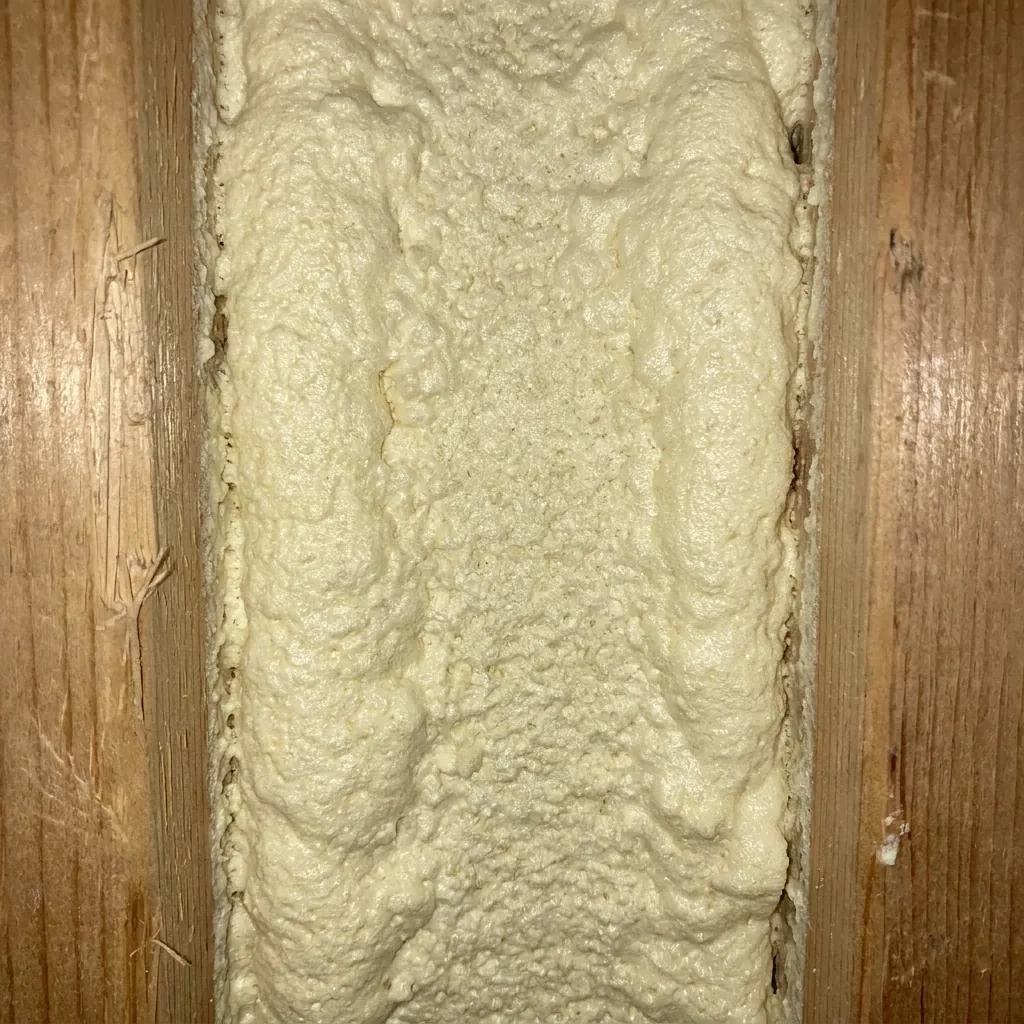
Spray foam is made on site from two liquids, an A side and a B side, heated and mixed at the gun. Get the ratio, temperature, surface, or pass thickness wrong and the foam shows it. The Center for the Polyurethanes Industry's inspection guidance and the trade press describe the same handful of symptoms.
- Sound foam: firm, bonded to the sheathing and the rafters, no gaps.
- Shrinkage: foam pulled away from a rafter, leaving a crack that leaks air.
- Delamination: foam let go of the deck, often after spraying on a cold or damp surface.
- Off-ratio foam: off-color, and soft and sticky or hard and brittle.
- Roofing nails through the deck: a hazard for anyone cutting foam out from below.
- A roof leak above wets the sheathing, and the foam below hides it from the attic.
- An inspection core: a small plug cut through the foam so a moisture meter can read the wood.
Soft, Sticky, or Brittle Off-Ratio Foam
CPI's guidance on sampling installed foam lists what goes wrong at the rig: "line or strainer blockages, running out of one material and pump cavitation" can all upset the ratio. The foam tells you which way. Too little A side makes foam that is "lighter than normal" and "sticky, spongy, soft." Too little B side makes it "darker than normal" and "brittle, hard, glassy." A builder-focused troubleshooting article in JLC adds that B-rich foams "tend to be soft and gummy and are more likely to have a high odor." Press firmly on closed cell foam with a gloved thumb: it should be rigid. Open cell is soft by design, so softness alone is not a symptom; tackiness, crumbling, and odd color are.
Shrinkage, Cracks, and Pull-Away From Framing
Shrinkage shows up as foam pulling away from the sides of rafters or studs, or cracking across a bay, and CPI's guidance says "shrinkage resulting in cracks is considered a defect." The gaps matter because spray foam's job is the air seal; a bay that has pulled back a quarter inch on both sides leaks around the insulation. JLC lists shrinking and cracking, voids and fissures, and poor adhesion as what follows when a single application factor is wrong.
Delamination From Cold or Wet Substrates
Delamination, in CPI's words, is when "the bond between the SPF and the substrate or a prior foam pass is broken." Tap or press along the foam where it meets the deck: a hollow sound or foam that flexes away from the board means it has let go. This is a Wisconsin-winter problem. Manufacturers set hard limits on the surface: Huntsman's Heatlok HFO EZ data sheet calls for a substrate and ambient temperature above 50°F, wood moisture of 19 percent or less, and a surface at least 5 degrees above the dew point. Owens Corning's closed cell guide sets wood at under 18 percent moisture and no spraying above 85 percent relative humidity. Cold-weather grades exist and carry lower limits, so the number that applies is the one on the data sheet for the product that was sprayed. A roof deck in a January attic, or framing left out in a wet fall before the house was closed in, can be outside those limits unless it was heated and checked first. JLC explains why: on a damp surface "the moisture acts as a blowing agent" that reacts with the A side, which leaves off-ratio foam with poor adhesion at the very layer that should be bonded.
Too-Thick Passes, Scorching, and Charring
Foam gets hot as it cures. EPA's draft contractor checklist says two inches or less is a typical lift for medium-density closed cell foam, that a 2-inch lift can reach 130 to 150°F at the core, and that lifts that are too thick can "char the foam; and result in scorching, igniting, off-gassing, and shrinkage." Carlisle warns that exceeding its pass thickness can cause spontaneous combustion "even hours after product was applied." Some newer high-lift foams are listed for much thicker passes, so pass thickness is product-specific. Cut a slit through a suspect area and look at the middle: a brown or burnt core is the sign. Once a section is scorched, that section's foam is the problem, not just the surface.
03 the smell question
Spray Foam Odor: What's Known and What Isn't
Some smell on spray day is normal. CPI's guidance says odors during application "are common and normal" and "generally dissipate" once the job is done and the area is ventilated. How long before people move back in is set by the product: Owens Corning's closed cell guide gives 24 hours as the standard re-occupancy time, and one Huntsman open cell sheet lists 4 hours at its stated ventilation rates. A smell that is still there weeks later is not normal, and that is when people start searching for spray foam removal.
Fishy Amine Odor From Misapplied Foam
A paper in an ASTM technical publication on misapplied spray foam says the problem "is suggested by a persistent 'fishy' type of odor after installation," and that tertiary amines from the foam's catalysts are significant contributors to it. The same paper names the causes: layers too deep, too little time between layers, and wrong ratio, temperature, or mixing. Carlisle's guide says improperly installed foam can cause "offensive odors that may or may not dissipate." Two honest limits go with that. EPA says the potential for off-gassing from spray foam "is not fully understood and is an area where more research is needed." And CPI points out that lingering odors can come from other things, including other building materials, "old house" smells that were there before, and misrouted plumbing vents. A smell in a house with new foam is not proof the foam is the source.
Who to Contact About a Spray Foam Odor Complaint
EPA's archived homeowner guidance lays out an order, and it is a sensible one:
- Work with the contractor to identify the problem, or consider hiring an independent expert such as a qualified indoor air quality (IAQ) consultant to diagnose the source.
- If anyone has breathing problems or other health effects, get medical attention right away.
- If the foam is shown to be the source, contact the contractor and the product manufacturer for help solving it.
- If that doesn't resolve it, contact your state or local consumer protection office or the contractors' licensing board. EPA also points to reporting at SaferProducts.gov.
Before those calls, write down what you can: the installer's name, the date, the product name and lot if it is on the invoice or a label at the attic hatch, where the smell is strongest, when it is worse, and photos of the foam. Keep a sample of any suspect foam in a sealed bag. That record is what an installer, a manufacturer's representative, or an IAQ consultant will ask for first.
Why Spray Foam Removal May Not Fix the Smell
EPA says that when foam was not applied properly, chemical contaminants "may have migrated to hard and/or soft surfaces elsewhere in the building and may be the source of residual odors; therefore, removal may not resolve the issue." The ASTM paper describes a mitigation process of removal, cleanup, resealing the surface with properly cured foam, and ventilation, and then says that "field practices used to control odors have not been validated." That's an uncomfortable answer, but it is the honest one: removal can be the right call for off-ratio foam, and it still may not be the end of the smell. Diagnosis should come before demolition.
04 buying and selling
Spray Foam and Selling a House: Home Inspections
The most common reason a Chippewa Valley homeowner first hears the phrase "spray foam removal" is a buyer's inspection. The foam usually isn't the issue. The issue is that the inspector can no longer see what it covers.
Why Inspectors Flag Spray Foam on Roof Sheathing
InterNACHI's article on inspecting foam under roof sheathing lists the primary risks as "rainwater leaks, condensation from diffusion, air leakage, and built-in construction moisture," and says damage could occur if the wood was above 18 percent moisture when it was sprayed. A home inspector writing in the ASHI Reporter in January 2026, in an opinion piece rather than ASHI policy, said foam on the deck "makes it harder to detect roof leaks" and that "buyers and inspectors often view spray-foamed roof decks with skepticism." In this climate the worry has a real basis. Green Building Advisor has reported OSB sheathing on many foam-insulated roofs staying damp for months, mostly with open cell foam, and Building Science Corporation's field study for the Department of Energy found that when foam-insulated wood roofs fail, it is typically from bulk water leaks or vapor diffusion condensation. Wisconsin sits in climate zones 6 and 7, where the model residential code, IRC Section R806.5, requires foam against a roof deck to be a Class II vapor retarder itself or to carry one directly on its underside. Open cell foam doesn't meet that on its own, a point covered on our closed cell vs open cell page.
Moisture Readings and Inspection Cores Before Removal
There is a step between "can't see it" and "tear it all out." When Building Science Corporation studied foam-insulated roofs for DOE, it evaluated them by visual inspection and core samples, "supported by quantitative moisture meter readings." The same approach works on a house for sale: cut small cores through the foam at the likely trouble spots (low on the roof, under valleys, around chimneys, vents, and skylights, and on the north slope), read the sheathing with a moisture meter, look at the wood, and seal the holes afterward. BSC found every in-service roof it opened well within the safe moisture range for wood sheathing. Dry readings, photos, and the original install paperwork answer most buyers' questions. Wet readings tell you exactly where the foam has to come off and where the roof needs work. Who cuts the cores should be agreed in writing between buyer and seller, because it is invasive.
Lenders, Appraisers, and Shingle Warranties on Foam-Covered Decks
We could not find a published Fannie Mae, FHA, or insurer rule in the United States against spray foam on a roof deck, so we won't claim one. That doesn't mean nobody in the sale will ask about it, and the same ASHI Reporter author wrote that many shingle manufacturers warn that foam applied directly to the roof deck can void their warranty; check your shingle maker's warranty terms before assuming either way. In the United Kingdom, where mortgage lenders have pushed back harder, the surveyors' body RICS published a consumer guide in 2023 calling spray foam "a significant and fundamental alteration to a home." That is UK context, not a Wisconsin rule. Whether foam on the deck was the right choice for a particular attic in the first place is a separate decision, covered on our attic insulation page.
05 what the work involves
How Spray Foam Insulation Is Removed
The industry's best single reference is the Center for the Polyurethanes Industry and Spray Foam Coalition's 2016 Guidance on the Removal and Disposal of High-Pressure SPF Insulation, which SPFA links from its health and safety page. It puts decisions about removal technique, protective equipment, and disposal in the hands of a "Competent Person" on site. What follows is a summary of that guidance and EPA's, so you know what a removal crew should be doing. It is not a how-to and not a description of our work.
Containment, Lockout, and PPE for Spray Foam Removal
Cured foam is not dangerous to touch, but cutting it makes dust. CPI calls that dust a nuisance particulate and a respirable dust hazard during removal. Its guidance calls for plastic sheeting and masking to build negative-pressure containment, exhaust ventilation, and circuits locked and tagged out, with plumbing and gas lines turned off and depressurized. For workers it lists an air-purifying respirator with particulate and, where needed, chemical vapor cartridges, or a supplied-air respirator in enclosed or poorly ventilated spaces, plus goggles, gloves, coveralls, and hearing protection. The household usually stays out of the work area. Heat is the line not to cross: EPA says plumbers and electricians "should not heat or grind spray foam," and that hot work on or near foam can expose people to isocyanates and other toxic emissions.
Hand-Cutting Soft, Low-Density Spray Foam
Open cell foam is soft and cuts like a dense sponge, which makes it the easier of the two to remove. CPI lists a long-handled serrated trowel or drywall saw, a putty knife or ice scraper, and a powered wire brush for what is left on the surface. In practice the bays are cut along the framing and the foam pulled out in chunks, then the remaining skin scraped down.
Sawing and Scraping Rigid, High-Density Foam
Closed cell foam is rigid and bonded hard to wood and steel, so removal is slower and rougher. CPI's guidance says power hand tools may be needed: reciprocating or circular saws, a sidewalk ice scraper or spud bar, or an electric power scraper. Fixr notes that foam in walls may need to be chipped free by hand, which raises the cost. Sometimes it is faster to cut out the drywall or the sheathing with the foam still attached and replace them, especially when the wood is already damaged.
Residual Foam, Roofing Nails, and Substrate Loss
Foam doesn't come off clean. CPI says removing the last layer usually takes a thin layer of the substrate with it, and that grinding, brushing, or sand and bead blasting can make significant dust; cryogenic (dry ice) blasting is another option it mentions. Under a shingled roof deck, it warns, there may be "numerous nails protruding below the roof deck," which is a hazard for anyone working overhead. Older Eau Claire houses with board sheathing can have gaps between the boards that foam has filled from behind, so getting it truly clean there may not be realistic. The usual goal is a sound surface ready for whatever goes back, not bare wood.
Disposal of Removed Spray Foam
CPI's guidance calls for bagging removed foam in heavy plastic bags and cleaning up with a HEPA vacuum. It says the components of spray foam "are generally not considered a hazardous waste," but that it is the waste generator's responsibility to make that determination under federal rules, 40 CFR 262.11. A removal bid should say where the material is going and who is responsible for that call. Bulky as it is, cut-up foam adds up to a lot of bags, and hauling is a real line item.
About doing it yourself: cutting out a small patch of open cell foam to reach a wire is ordinary work. Stripping a whole attic or cutting closed cell overhead, around roofing nails, under a hot roof, is not. HomeAdvisor and Angi both advise against DIY insulation removal in general, and EPA's warning about heat-generating tools applies to anyone holding the saw. If the reason for removal is odor or suspected off-ratio foam, don't start cutting before the installer and manufacturer have seen it, because the evidence goes into the dumpster with the foam.
06 four ways forward
Spray Foam Removal Options, Side by Side
Leaving it, cutting out a section, and stripping it all are the real choices, and they differ a lot in disruption and in who does the work.
| Question | Leave it and document | Localized cut-out and repair | Full spray foam removal | Removal plus replacement |
|---|---|---|---|---|
| When it fits | Foam is cured, bonded, odor-free; cores and moisture readings are dry | A few bays: a leak spot, wet board, shrinkage, or access for wiring or framing work | Confirmed off-ratio foam throughout, or a deck or ceiling that is coming out anyway | Any full removal in a heated space; the house still needs an air seal and insulation |
| Who usually does it | Home inspector or contractor for cores and readings; the owner keeps the records | Removal or remediation contractor, or the original installer if it is their defect; roofer or carpenter for wood repairs | An insulation removal or remediation contractor, after the installer and manufacturer have weighed in | Removal contractor, then repair trades, then an insulation installer |
| Disruption | Low: a few small holes, patched | Moderate in that area: containment, dust, cutting | High: containment, days of cutting and scraping, many bags out | Highest: everything in full removal, then a new installation |
| What the sources say | Fixr: in most cases foam doesn't need to come out | CPI's removal guidance covers construction changes and fire, flood, or mold damage | Carlisle: off-ratio foam must be completely removed and replaced. EPA: removal may not resolve an odor | CPI: removal usually takes a thin layer of the substrate with it |
| Biggest risk | Missing a slow leak if readings were skipped | Patch sprayed on a still-wet board | Odor persists anyway; nails, dust, and heat during removal | Replacement installed before the roof leak or deck is fixed |
Sources are listed under the FAQ. "Original installer" means the company that sprayed the foam, working with the manufacturer, when a defect is theirs to address.
07 the money
Spray Foam Removal Cost Drivers
These are national figures from consumer cost guides, not our prices. Eau Claire Spray Foam Pro does not remove spray foam or price removal. Published removal numbers specific to spray foam are scarce, which is itself worth knowing: most cost guides price insulation removal in general, mostly loose-fill and batts, which come out much more easily.
Published National Spray Foam Removal Ranges
- Fixr, updated January 31, 2025: "expect costs of between $1.50 and $3 a square foot to remove the insulation," and closer to $5 a square foot when the foam has to be chipped free by hand. Fixr says cost varies with the foam's type, depth, and condition.
- HomeAdvisor, updated June 20, 2026: its insulation removal guide puts attic insulation removal in general at $1 to $2 per square foot, with a $900 average project, and says "spray foam insulation costs more to remove" than blown-in, which can be vacuumed. It gives no foam-specific figure, and the page notes it was updated using automation.
What Moves a Spray Foam Removal Price
- Foam type: soft open cell cuts out far faster than rigid, bonded closed cell.
- Thickness and area: square footage of surface, and how many inches have to come off it.
- Where it is: an attic roof deck overhead with nails through it, a tight crawl space, or a finished wall all go slower than open framing.
- How clean is clean: cut out to the framing, scraped, or blasted down to a sound surface.
- Containment and protection: negative-pressure setup, protecting finished rooms, and keeping dust out of the HVAC.
- Drywall or sheathing: cutting out and replacing finishes or boards with the foam attached.
- Hidden damage: rotted sheathing or framing found once the foam is off, usually priced as an allowance or a change order.
- Hauling and disposal: bag count, dumpster, and the disposal determination.
- Cleanup and odor work: HEPA cleanup and any surface sealing or ventilation steps.
- What goes back: replacement air sealing and insulation is a separate job and a separate price.
If the foam is defective, the cost question changes: who pays may be a matter between the owner, the original installer, and the manufacturer, which is one more reason to document before anyone cuts. For pricing new insulation after removal, the cost calculator carries planning ranges.
08 putting it back together
After Spray Foam Removal: What Goes Back In
An attic or wall with the foam stripped out has no air seal and no insulation, and in a Chippewa Valley winter that can't wait long. The order matters more than the material.
Roof Deck and Framing Checks Once the Foam Is Off
With the foam gone, the sheathing and framing are visible for the first time since the install. That is the moment to read moisture, probe soft spots, and look for stains that trace back to a roof leak, a flashing problem, or a bath fan venting into the attic. Fix the roof and any rot before new insulation goes in; otherwise the same water problem is just covered up again. If the roof leaked, that's a roofer's job first.
Air Sealing and Replacement Insulation After Removal
The replacement doesn't have to be foam. If the attic can go back to a vented attic with insulation on the floor, sealing the ceiling's air leaks and then blowing loose-fill is often the cheaper route; our blown-in attic insulation guide covers that option, and it isn't work we do. If insulation stays at the roof deck, Wisconsin's climate zone means it needs a vapor retarder that works, and in our view, and in Building Science Corporation's guidance, that means closed cell against the deck. Rim joists and crawl spaces have their own details, on the rim joist and crawl space pages.
Who Installs the Replacement Spray Foam
Removal contractors don't always install, and installers like us don't remove. If the replacement is spray foam, get it priced as its own job after the deck has been checked and repaired, from an installer who will name the product, the pass thickness, and the substrate temperature and moisture limits from the data sheet. Those limits are exactly what went wrong in most of the failures described above. If the original installer is redoing its own defective work, ask for the same things in writing.
09 hiring it out
Finding a Spray Foam Removal Contractor
Spray foam removal is usually done by insulation removal or remediation contractors, sometimes as part of a bigger repair handled by a general contractor. We won't recommend or rank anyone by name. Before calling anyone, though, call the original installer if the foam is defective: a reputable installer usually wants to see a failed job and involve the manufacturer, and a fix may be theirs to make. Get at least two written bids for the removal.
What a Good Spray Foam Removal Bid States
- Scope by area: which rooms, bays, or square footage come out, and what stays.
- Method: hand tools, power saws, scraping, or blasting, and how clean the finished surface will be.
- Containment: plastic and negative pressure, protection for finished rooms, and HVAC shut down or sealed off.
- Safety: respirators and PPE, circuits locked out, gas and water lines handled, and no heat-generating tools on the foam.
- Disposal: how the foam is bagged, hauled, and where it goes, and who makes the waste determination.
- Deck and framing check: moisture readings and a written condition report once the foam is off, with photos.
- Repairs: whether rotted sheathing or framing is included, priced as an allowance, or left to another trade.
- Cleanup: HEPA vacuuming and how the space is left.
- What goes back: whether replacement air sealing and insulation are included, what product, and who installs it.
- Schedule and occupancy: how many days, and which parts of the house are off limits while work is under way.
Questions to Ask a Spray Foam Removal Contractor
- How much spray foam, not loose-fill, have you removed, and was it open cell or closed cell?
- Who on the crew decides on the method and PPE, and what respirators will they wear?
- How will you keep dust out of the rest of the house and the ductwork?
- What do you do when you find wet or rotted sheathing, and how is that priced?
- If this is about odor, have the installer and manufacturer been involved, and should samples be kept first?
- Will you give me moisture readings and photos of the deck once the foam is off?
- What insulation goes back, who installs it, and how soon?
10 asked often
Spray Foam Removal FAQ
Can I remove spray foam insulation myself?
A small patch of open cell foam, cut out by hand to reach a wire or a pipe, is ordinary work. A whole attic is not: closed cell foam is bonded hard, roofing nails poke through the deck overhead, and cutting makes dust that calls for containment and a respirator. EPA warns against heating or grinding foam, and cost guides advise against DIY insulation removal in general. If odor or bad foam is the reason, have the installer and manufacturer look before anything is cut.
How long should spray foam smell after it is installed?
Industry guidance says odors during spraying are common and generally dissipate once the job is done and the space is ventilated. Re-occupancy time is product-specific: 24 hours is a common standard, and some open cell products list shorter times. A smell that persists for weeks, especially a fishy one, is a reason to contact the installer and manufacturer, and possibly an indoor air quality consultant.
Will spray foam on the roof deck hurt a home sale?
It can raise questions, because an inspector can't see the sheathing behind it or spot roof leaks from the attic. It doesn't mean the house has a problem. Inspection cores with moisture readings, photos, and the original install paperwork answer most buyers. We found no published U.S. lender or FHA rule against spray foam on a roof deck; check your shingle maker's warranty terms separately.
Which kind of spray foam is hardest to remove?
Rigid closed cell foam. Open cell foam is soft and can be cut out with a serrated knife or saw and scraped. Closed cell is rigid and bonded hard to wood, so industry guidance lists reciprocating or circular saws, spud bars, and power scrapers, and some foam may have to be chipped free by hand, which costs more.
Does removing spray foam damage the wood behind it?
Usually a little. Industry removal guidance says removing the last layer of foam typically takes a thin layer of the substrate with it, and on board sheathing foam fills the gaps between boards. The goal is a sound surface ready for new insulation, not bare wood. Damage found under the foam, like rot from an old roof leak, is a separate repair.
Is removed spray foam hazardous waste?
Industry guidance says spray foam components are generally not considered hazardous waste, but it is the waste generator's responsibility to make that determination under federal rules. A removal bid should say how the foam will be bagged and hauled, and where it goes.
Does Eau Claire Spray Foam Pro remove spray foam?
No. We install spray foam insulation. We do not remove spray foam, remediate odors, or price removal work. For removal, owners usually hire an insulation removal or remediation contractor, and for a defective job, the original installer and the foam manufacturer are the first calls.
Sources:
- EPA (archived, last updated Sept. 2, 2020): Potential Chemical Exposures From Spray Polyurethane Foam; Health Concerns About SPF; Checklist for Professional SPF Insulation Contractors (2015 working draft)
- CPSC: SPF Insulation Health and Safety Recommendations for Consumers
- Center for the Polyurethanes Industry / Spray Foam Coalition: Guidance on the Removal and Disposal of High-Pressure SPF Insulation (March 2016); Guidance on Sampling Techniques for the Inspection of Installed SPF; SPFA Health & Safety
- Manufacturer data: Huntsman Heatlok HFO EZ; Huntsman Classic Ultra Select; Carlisle Foamsulate closed cell application guide; Owens Corning closed cell application guide; ICC-ES ESR-4073 (high-lift pass thickness)
- Failures and odor: Assessment and Remediation of Misapplied Spray Polyurethane Foam (ASTM STP1589, 2017); JLC, Troubleshooting Spray-Foam Insulation
- Roof decks and inspections: Building Science Corporation for DOE Building America, Application of Spray Foam Insulation Under Plywood and OSB Roof Sheathing (2013); Green Building Advisor, Open-Cell Spray Foam and Damp Roof Sheathing; InterNACHI, Inspecting Spray-Foam Insulation Under Roof Sheathing; ASHI Reporter, Why I Don't Like Spray Foaming Roof Decks (Jan. 2026, opinion); RICS consumer guide coverage (UK, 2023)
- Costs: Fixr, HomeAdvisor, Angi; national averages, not this business's prices.
Not Sure the Foam Is the Problem?
Not sure whether the foam in your attic is a problem or just unfamiliar? Call or text (715) 716-7940 and we'll tell you honestly what we see in your photos, including when the job belongs to someone else: the original installer, the foam manufacturer, a roofer, or a removal contractor. We install spray foam; we don't remove it. Clear photos of the foam where it meets the deck and framing, any stains, and the invoice or product label if you have them are the best place to start. More on what we do is on the Eau Claire Spray Foam Pro homepage.
Rather talk it through?
(715) 716-7940call or text, photos of the foam welcome